Menu
  Du Jardin Beauty
  • Home
    • Workshops & Events
    • Spotlight
    • Reviews & Testimonials
  • Shop
    • Luxury Skincare
    • Herbal Haircare
    • Best-Sellers
    • Multi-Purpose Utility Soaps
    • eGift Cards
  • GIVING BACK
    • Wild & Locally Sourced
    • Charity: New Hope Midcoast
    • Fair-Trade Items
  • LEARN
  • About Us
    • FAQ's & Policies
    • Contact
    • Services
  • Wholesale
  • Home
    • Workshops & Events
    • Spotlight
    • Reviews & Testimonials
  • Shop
    • Luxury Skincare
    • Herbal Haircare
    • Best-Sellers
    • Multi-Purpose Utility Soaps
    • eGift Cards
  • GIVING BACK
    • Wild & Locally Sourced
    • Charity: New Hope Midcoast
    • Fair-Trade Items
  • LEARN
  • About Us
    • FAQ's & Policies
    • Contact
    • Services
  • Wholesale

Du Jardin Learning Center

Herbal Spotlight: Limequats With Recipe for Limequat Curd & Tartlets

2/22/2021

3 Comments

 
Picture
Curd and Tartlets and Cocktails -- Oh My!
Q:   What do you get when you cross a kumquat with a Key-lime?
A:   A tiny piece of Heaven!
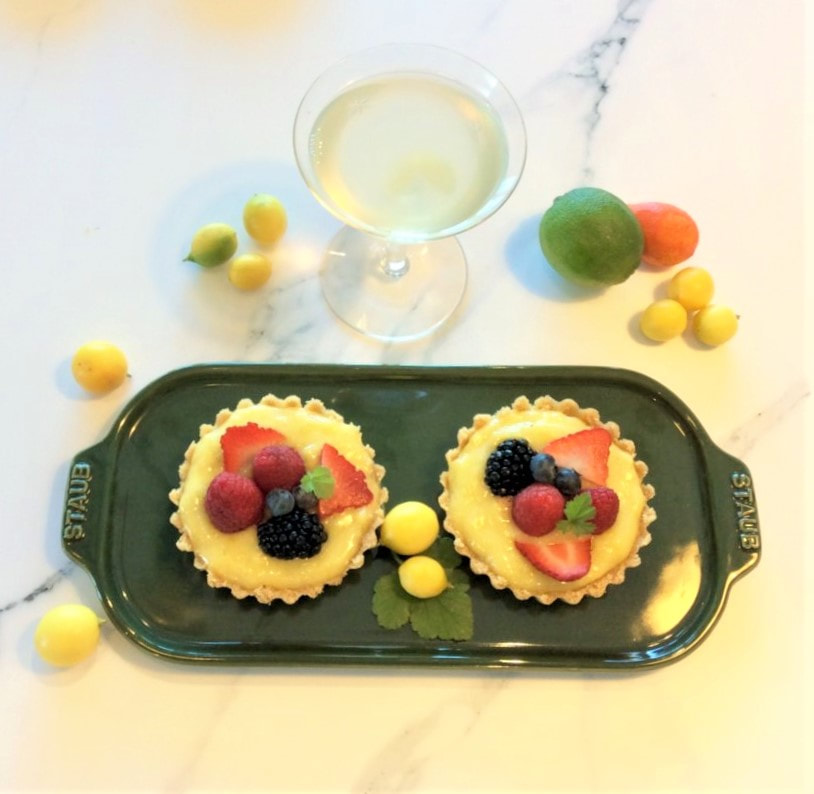
Limequats are my most anticipated item of the yearly Winter-Citrus season & I wait impatiently all year long for these delicacies to arrive! Imma go a little crazy with 'em this week -- there will be Limequat cocktails & marmalade, as well as Limequat Curd & gorgeous Limequat Tartlets with a super easy, no-bake
sablée crust. Pucker Up & come along!
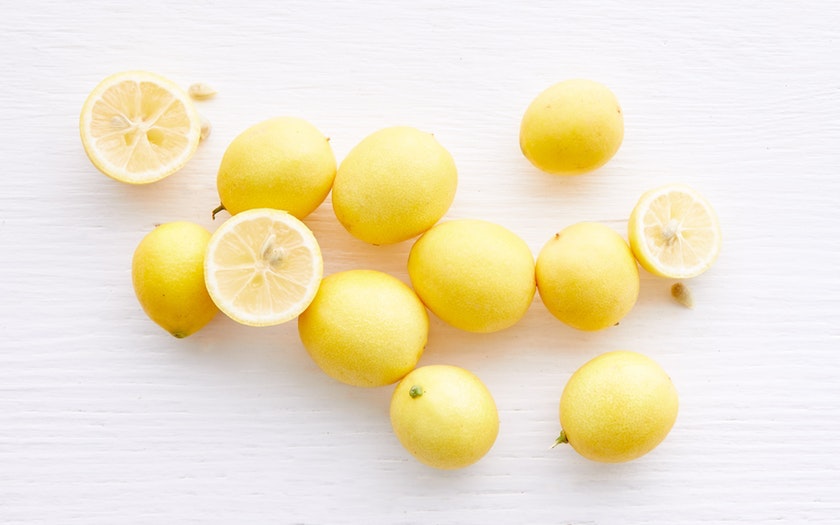
Limequats are the result of crossing Key-limes with kumquats in the early 1900s, a delicious hybrid known as Citrofortunella floridana. These bushy trees produce prolific amounts of fruit, which has reinforced their recent up-turn in popularity with home gardeners. [Oh! For my own heated conservatory I could grow them & vanilla orchids in! Sigh!] Limequats have a floral fragrance & unique, tangy-tart flavor. 
Picture
They are entirely edible like kumquats--seeds, peel, & all. [Most people find the seeds to be bitter & discard them] They are loaded with Vitamin C & folic acid, & have wide use applications. They can be eaten raw or cooked & work well in savory & sweet dishes & drinks, as do most citrus fruits. In our home it is a scramble to secure as many as we can each Winter & preserve a bunch to extend the season for our family. I make marmalade, curd, & syrups, being sure to freeze quite a bit in an attempt to last us the year. You can usually find them with the other Winter Citrus in specialty markets & maybe even your local Whole Foods -- We are very lucky indeed to be able to source them at our local Co-Op, Rising Tide.
Picture
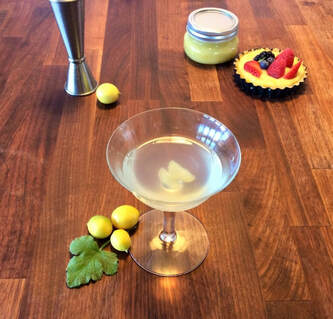
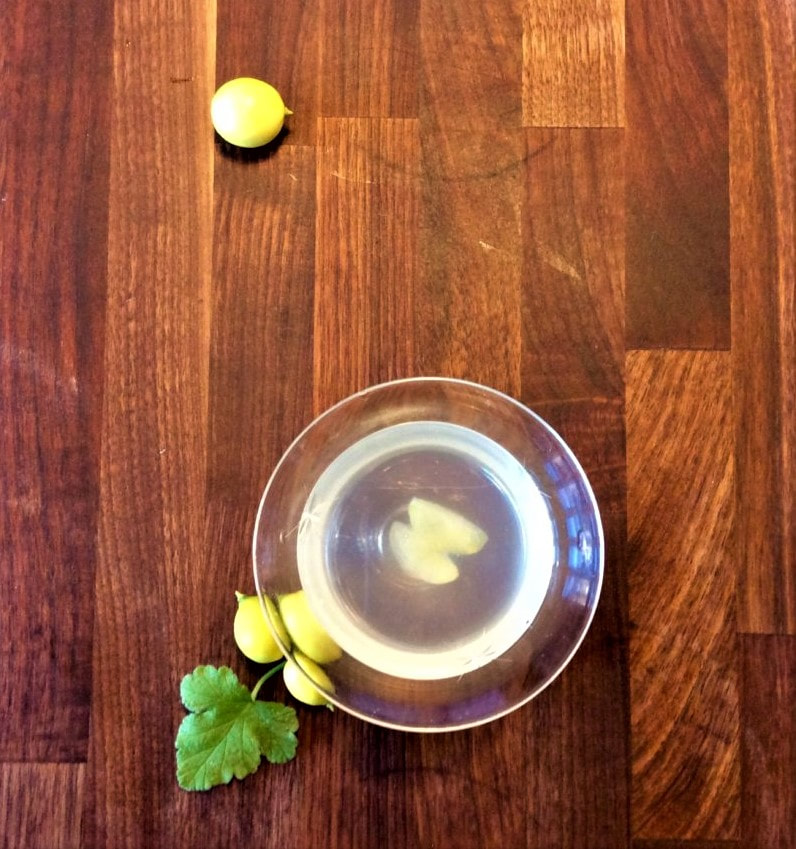
Limequat Aviations are one of my very favorites
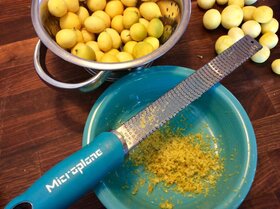
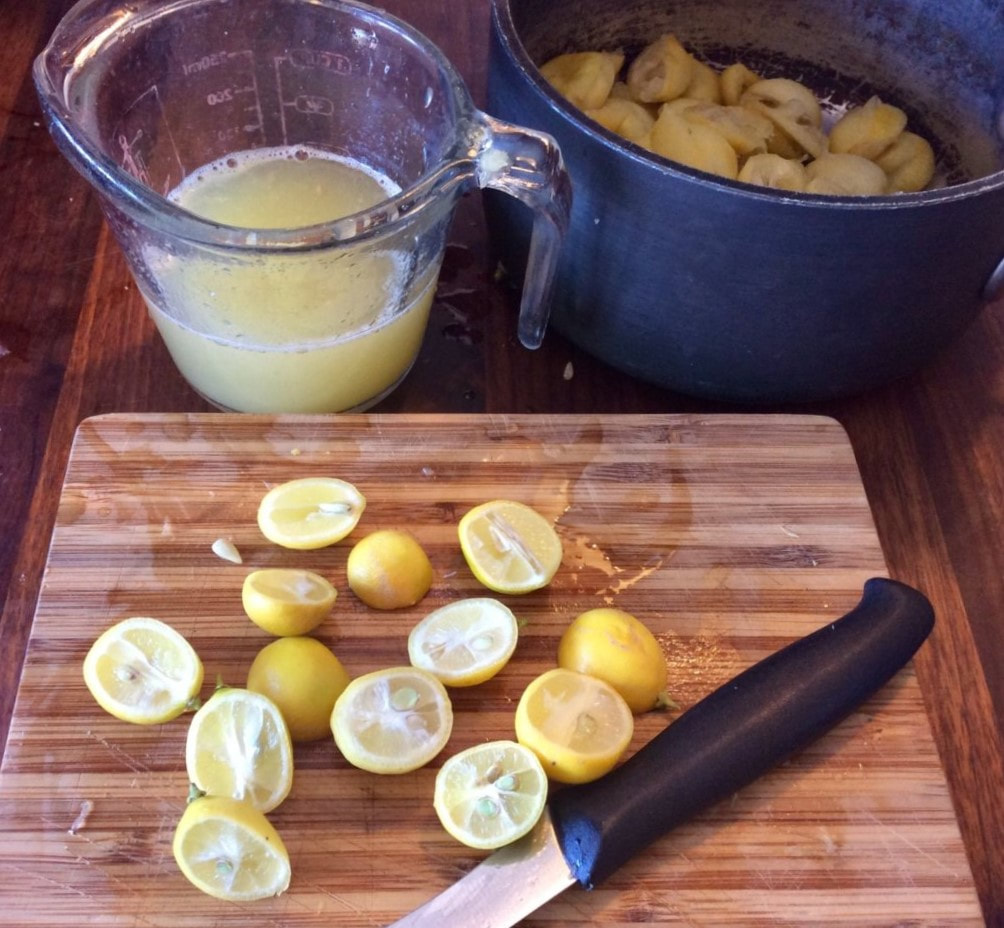
Their tart flavor works well with chicken & fish dishes. I adore using candied limequat halves as salad toppers as well, especially with a bright, apple-cider vinaigrette. But, my absolutely favorite way to enjoy them, unsurprisingly, is in curd & in cocktails. Making syrup not only yields lovely syrup which holds up in the freezer for a good 6 months, but also candied limequat pieces for salads & so is a huge Win-Win for us. I rely on the Power-Of-Three method for best syrup results with these tiny treasures -- Zest/Juice/Fruit.  I use the microplane to zest a few into my saucepan, cut a ​
handful in half & squeeze the juice in, AND add the halves as well to 1:1 water & sweetener. This method really makes the most of their amazing flavor. Once you strain off your syrup, simply pick out the seeds & let the fruit pieces cool-- then enjoy candied limequats on salads or as cocktail garnishes! Limequat syrup plays well with gin, tequila, & vodka, & it is particularly thirst-quenching in bubbly soda water as well for a simple, exotic homemade soda.
Martha Stewart has a dead simple recipe for no-cook Limequat Marmalade that is an amazing accompaniment to a cheese plate. It is also quite lovely with roasted chicken. For longer keeping, limequats make wonderful traditional marmalade preserves as well. Now, while both of these are worthwhile uses for limequats, Limequat Curd outshines them both. Ridiculously easy & outrageously delicious -- 
Picture
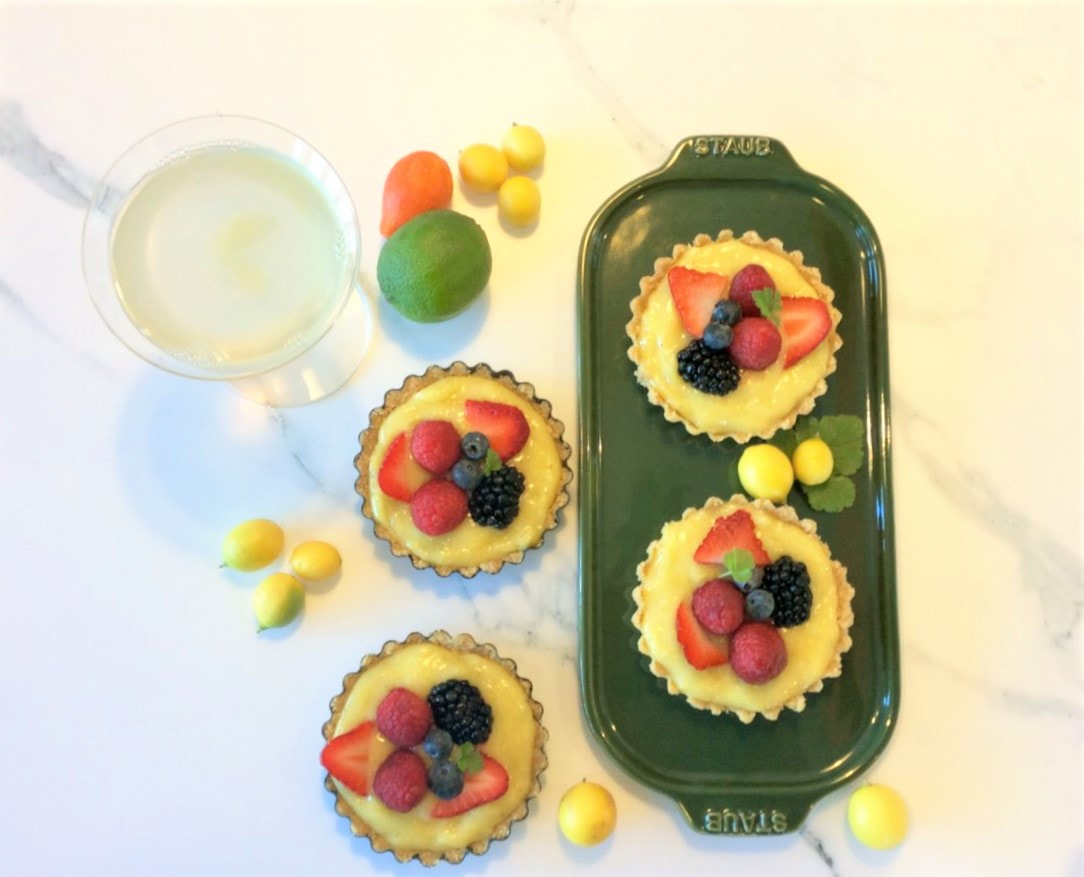
the curd is the way to go if you plan to only make one limequat recipe. Enjoy it on scones & toast [with or without clotted cream] or use it to fill tarts with my super quick [CHEAT!] sablée crust. You’ll be so glad you did! Here’s how:
Super Easy, No-Bake Sablée Crust for Tarts
10 oz Shortbread Cookies 
6 TBS Unsalted Butter, melted 
2 TBS Light Brown Sugar 
1 TBS Refined Sugar
Picture
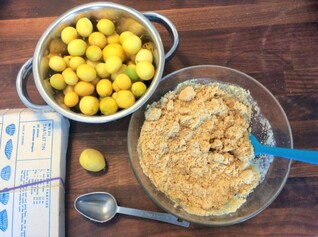
Process the cookies in a blender or food processor until even crumbs form. Add both sugars & pulse a few times to combine. Pour out into a mixing bowl & add the melted, working it into the crumb mixture evenly with a fork. Grease your pans & ramekins, then press an even layer of crumbs into them. Press it down firmly using fingers & the back of a metal measuring cup. That is IT! 
Refrigerate for at least 10 minutes before filling & you are all set! Seriously, no blind baking, no pie weights. You are good to go. This is enough to make a nice, thick crust for a large 9” tart or many smaller tartlets. Now on to the CURD!
Limequat Curd
3 Large Eggs 
1 cup Sugar 
⅔ cups Limequat Juice* 
2 TBS Limequat  Zest* 
4 TBS Unsalted Butter, small diced & chilled 
Pinch Sea Salt
* Feel free to add some regular lime juice &/or kumquat juice if you don't have enough limequats. For the zest, I highly recommend mixing in a little lime & kumquat zest with your limequats as the blend of yellow, green & orange is very pretty in the finished curd.
Zest your limequats [& any other fruit being used] & set aside. Juice your fruit & reserve, removing any seeds. I do not strain out the pulp from the fresh juice, as it adds such lovely flavor. Set up your double-boiler & simmer [or a stainless steel bowl placed over a saucepan of simmering water]. ​
Picture
Picture
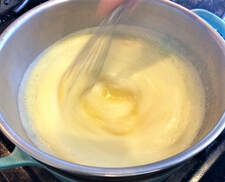
Add the eggs, sugar, & juice, & begin whisking to blend. Cook & continue whisking constantly to prevent the eggs curdling. It will foam up at first. As the foam dies down, you will see it start to thicken & get glossy. This should take between 5 & 10 minutes. ​
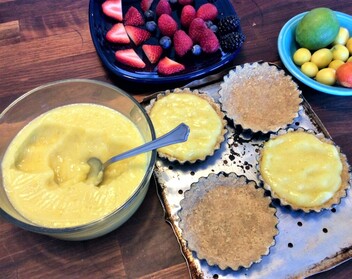
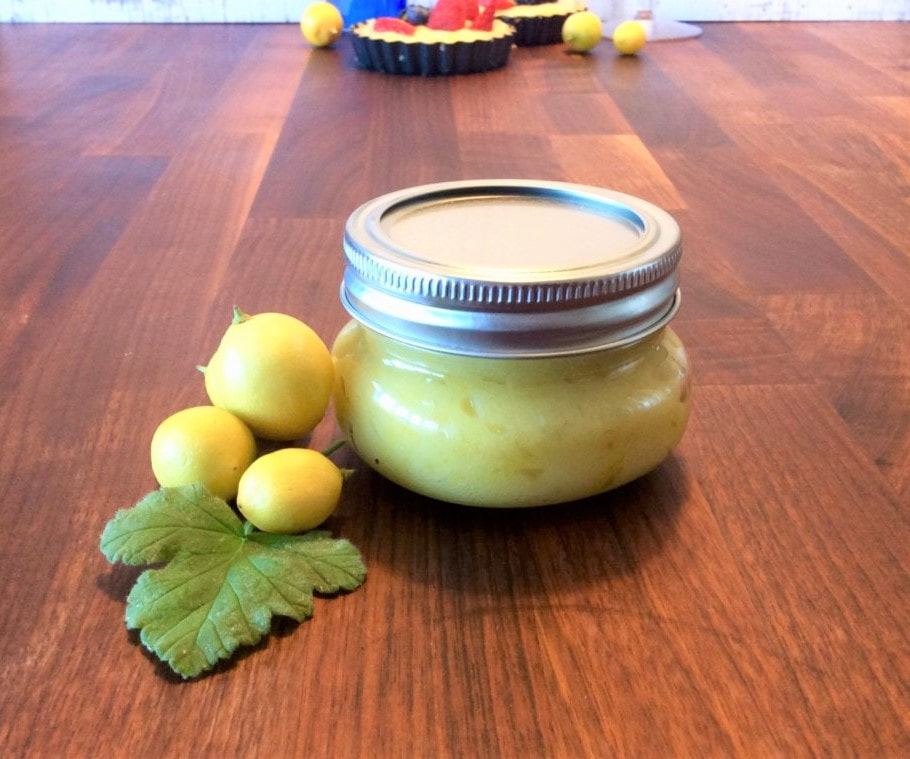
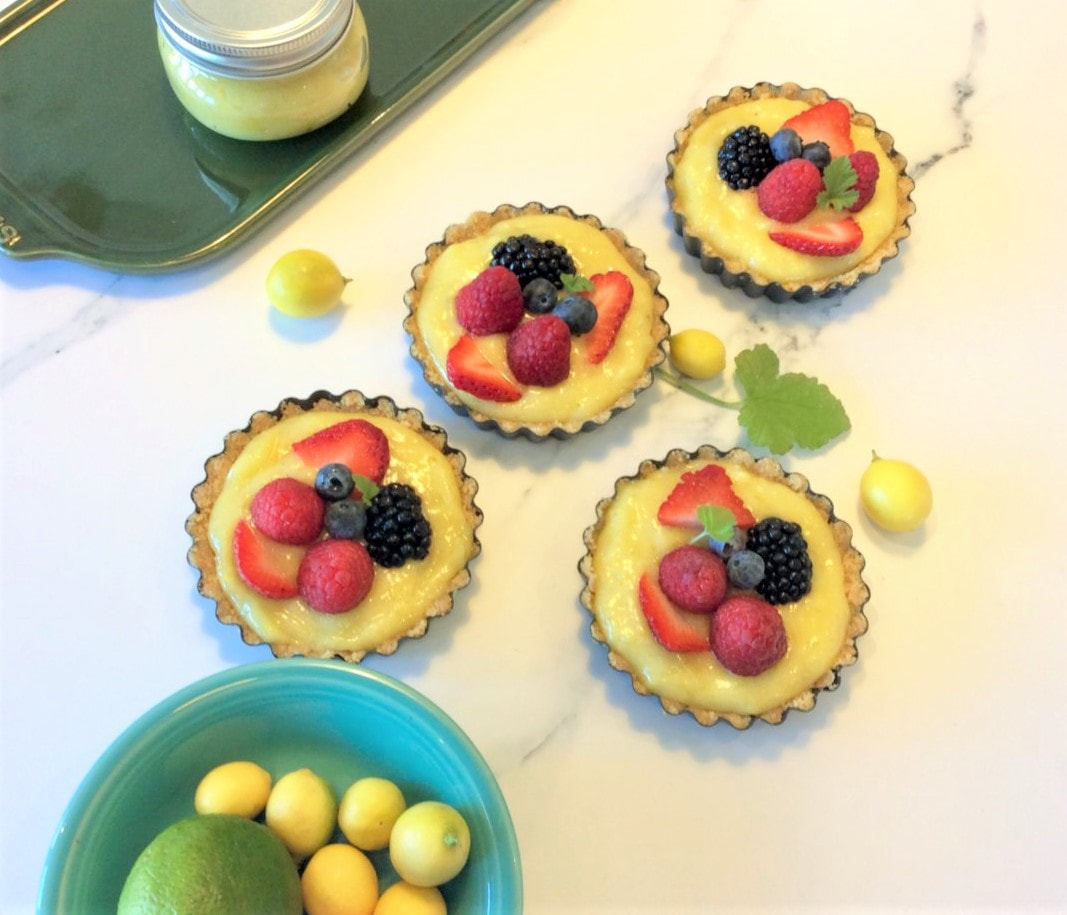
Once thick, remove from heat & begin to add the small pieces of butter, one at a time, whisking to incorporate. Once all of your butter has been whisked in, add the zest & pinch of salt. Voila, Limequat Curd! ​It will continue to thicken as it cools. This recipe makes about 3 cups of curd. Pop it into mason jars to store in the fridge -- These make lovely gifts if you are feeling generous! If you're making tarts, put the curd in the fridge to set-up & cool for at least 30 minutes before using it to filling. I like to top our Limequat Tartlets with fresh berries, but some whipped cream wouldn’t go wrong either.
Picture
Allow your curd to chill for at least 30 minutes before filling tarts.
There it is-- A pretty spectacular result from very little effort! I hope you enjoy the post & give the curd a try. It is always a hit. The tarts are so pretty too-- Please let me know what you think if you make it & share PICTURES!  Until next time -- Remember to  #StopAndEatTheFlowers
3 Comments

Herbal Spotlight: Scented Geraniums with My Rose Geranium Sorbet Recipe

2/8/2021

1 Comment

 
Scented geraniums [Pelargonium spp.] come in many scents [lemon, rose, mint] & with many different leaf shapes [variegated, lacey, full.] Today, we will explore them & some of their wonderful culinary uses--
You’ll also meet
Gerald, our 'Attar of Rose' geranium & score my super-easy recipe for delicious, creamy Rose Geranium Sorbet! 
​
Picture
Picture
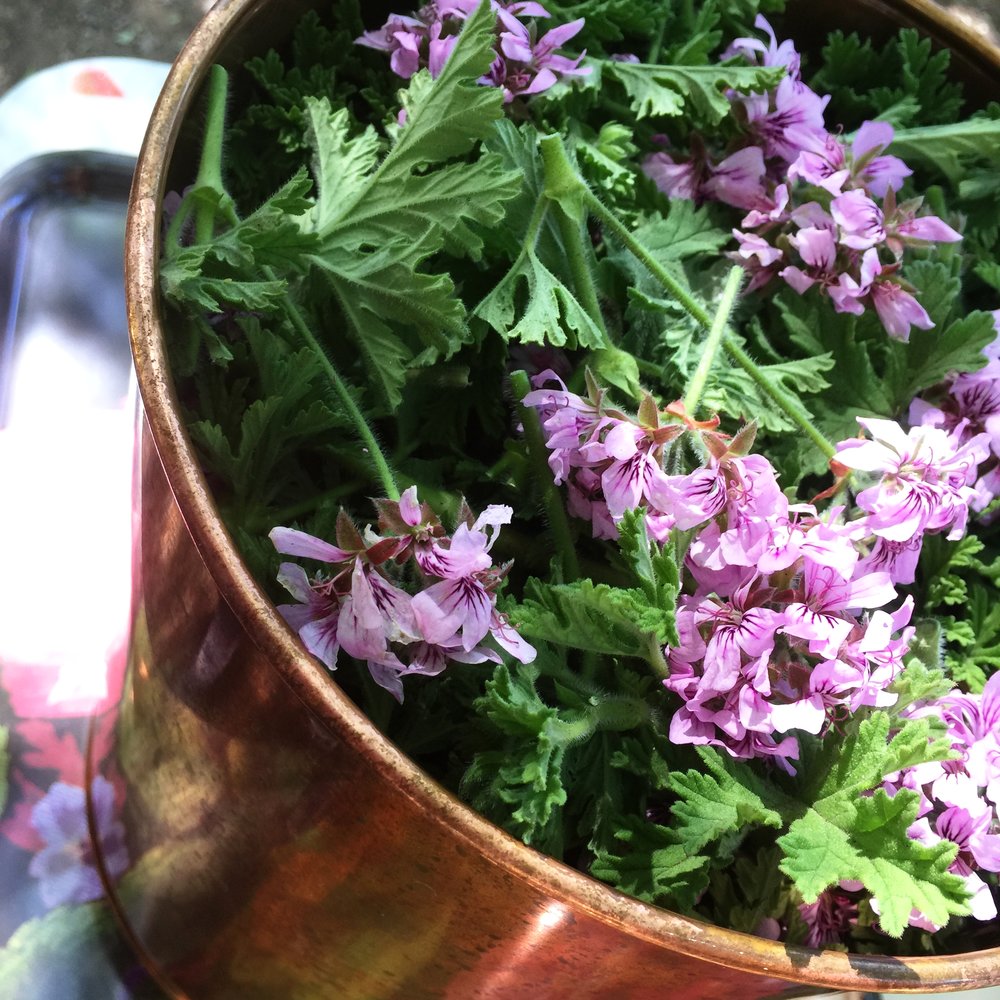
Beautiful scented geranium flowers.
The very term ‘Geranium’ is a cause for confusion, as it is commonly used to refer to many plants that are not actually geraniums…. And today’s subject is one of those plants! This focus is on Scented Geraniums, which are actually pelargoniums not true geraniums at all. Originating from Africa, these are tender perennials with highly fragrant leaves & stems; most varietes you find are hybrids with their fragrances falling into one of five categories: rose, citrus, mint, fruit/ nut, & pungent. There are dozens of varieties within each of these categories & I have yet to meet one that wasn’t fantastic. While they do produce pretty flowers, it is their leaves that are most useful. ​
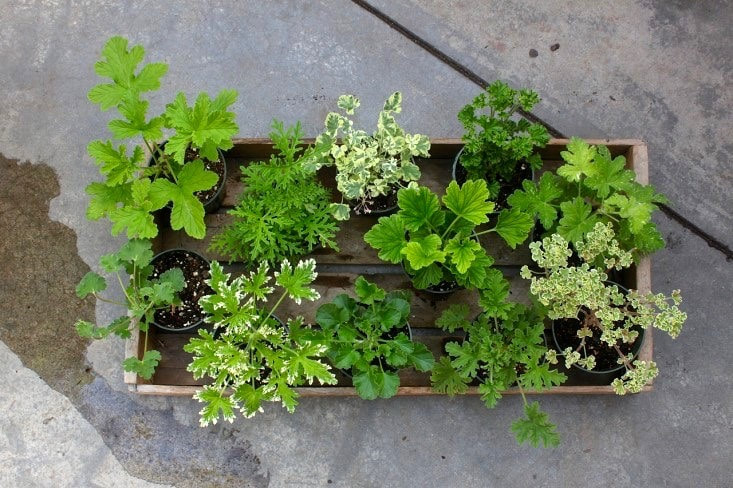
Scented geraniums have glands at the base of their leaf hairs, where the scent is formed. Crushing the leaves releases the oil, flavor, & the scent. You will find a wide variety of leaf shapes in these plants, with some having deeply filigreed, lacey leaves & others solid, lobed ones, some solid in color & others variegated or ringed. Their leaves are used medicinally, in cooking, for potpourri, aromatherapy, & in perfumery.​ Scented geranium leaves can be used to flavor teas, jellies, syrups, liqueurs, sorbets, & baked goods, & are quite delicious.
Picture
Examples of the many different types of scented geranium leaves. Photo: gardenista.com
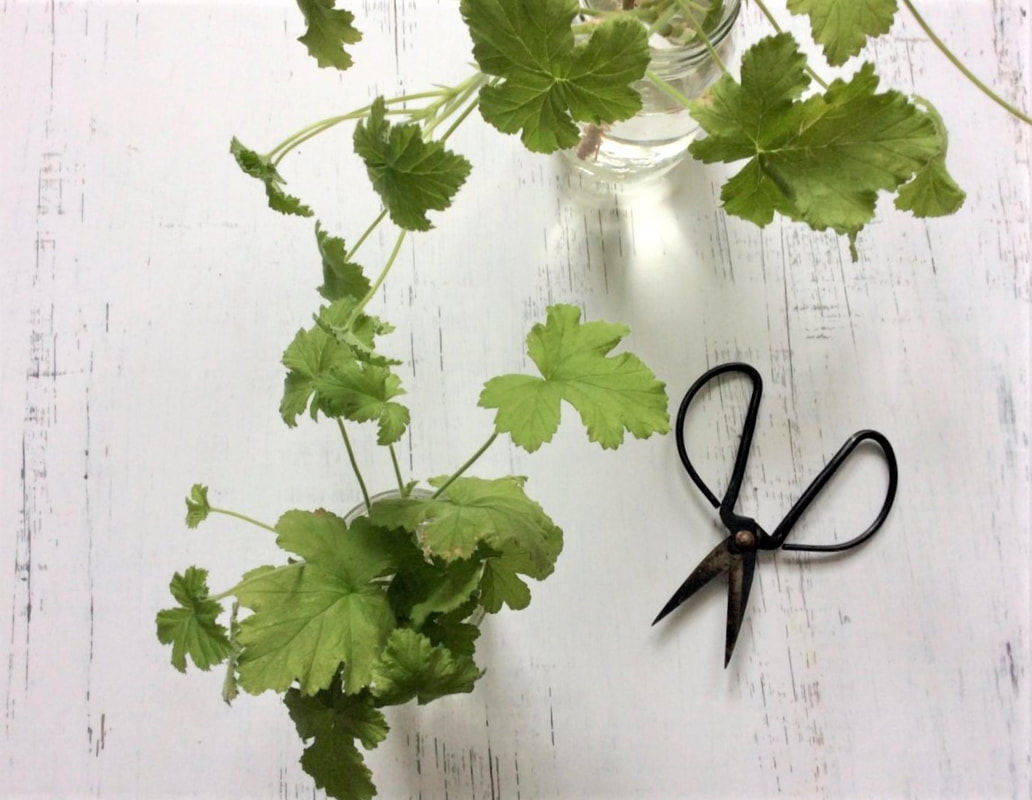
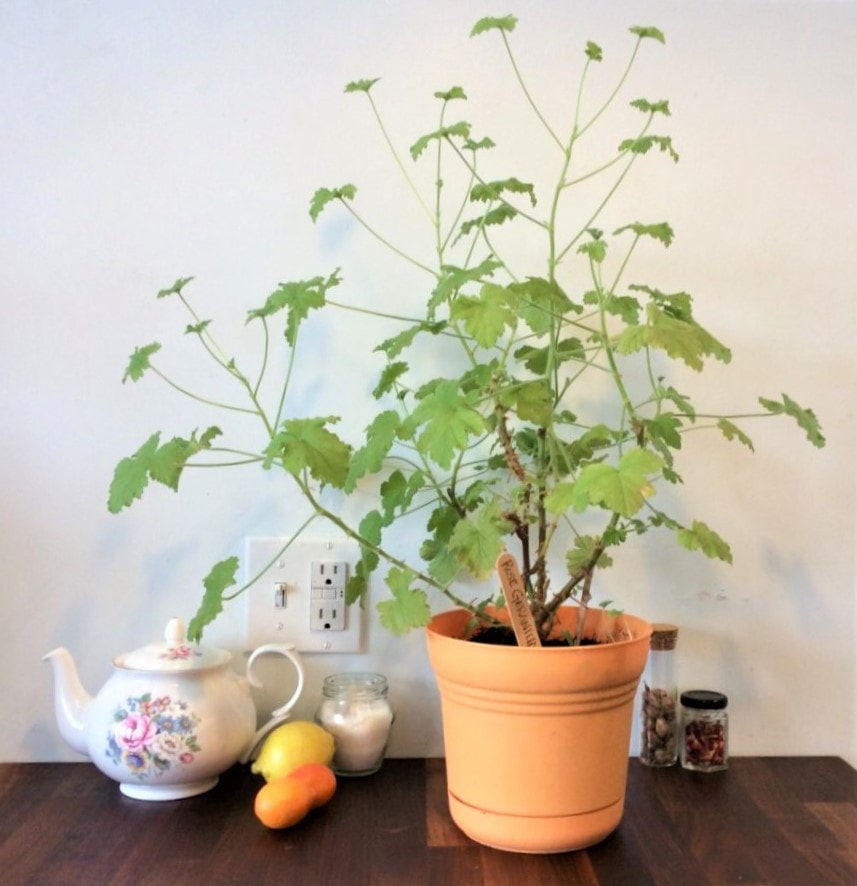
Hardy in zones 9 - 11, scented geraniums will not tolerate frost, but make lovely houseplants in lower zones & have no issues living in containers. Indoors, they will need some sun & will tend to get leggy when not regularly pinched back. Pinching them back also encourages flowering, & is rather a joy as a fresh leaf or 2 added to your morning cup of tea is lovely. I like to let ours get quite leggy, then give him a good haircut when the urge to make something strikes me. My favorites to make with the cuttings are Geranium Lemoncello, Geranium Blood Orange Curd, & the sorbet recipe I will share here -- which leads me to Gerald, our ‘Attar of Rose’ scented geranium. 
Picture
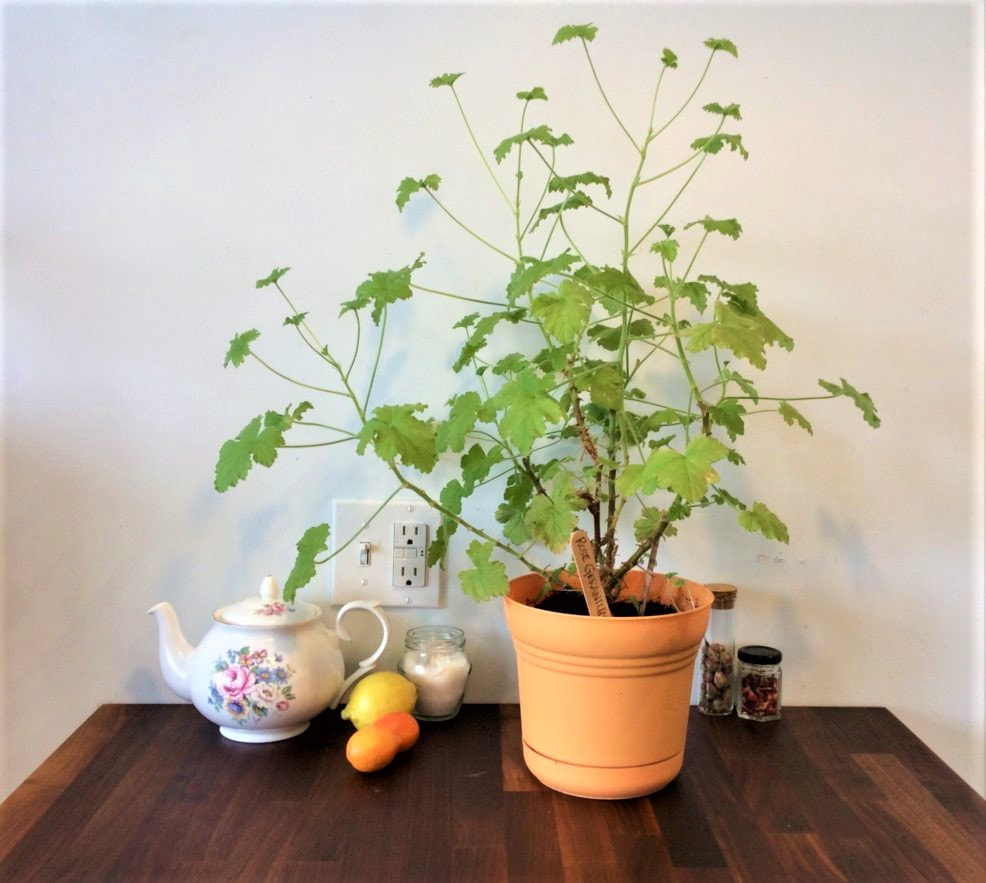
Meet Gerald, looking very leggy indeed just before his haircut!
Many years ago, my oldest daughter brought home a small cutting from a friend’s plant at school, & promptly named it Gerald. He has been with us ever since. Curious which type of scented geranium he was, I began researching & we learned he is actually a rather unusual cultivar in the rose-scented branch called ‘Attar of Rose.’ Most rose geraniums have lacey, cut leaves &/or showy variegations, but Gerald has simple, lobed leaves. Where he truly shines is in his flavor -- which is AMAZING! Softly floral with citrus notes, it is truly unique & delicious. In fact, my Hawaii-born husband insists our sorbet tastes rather like lychee! 
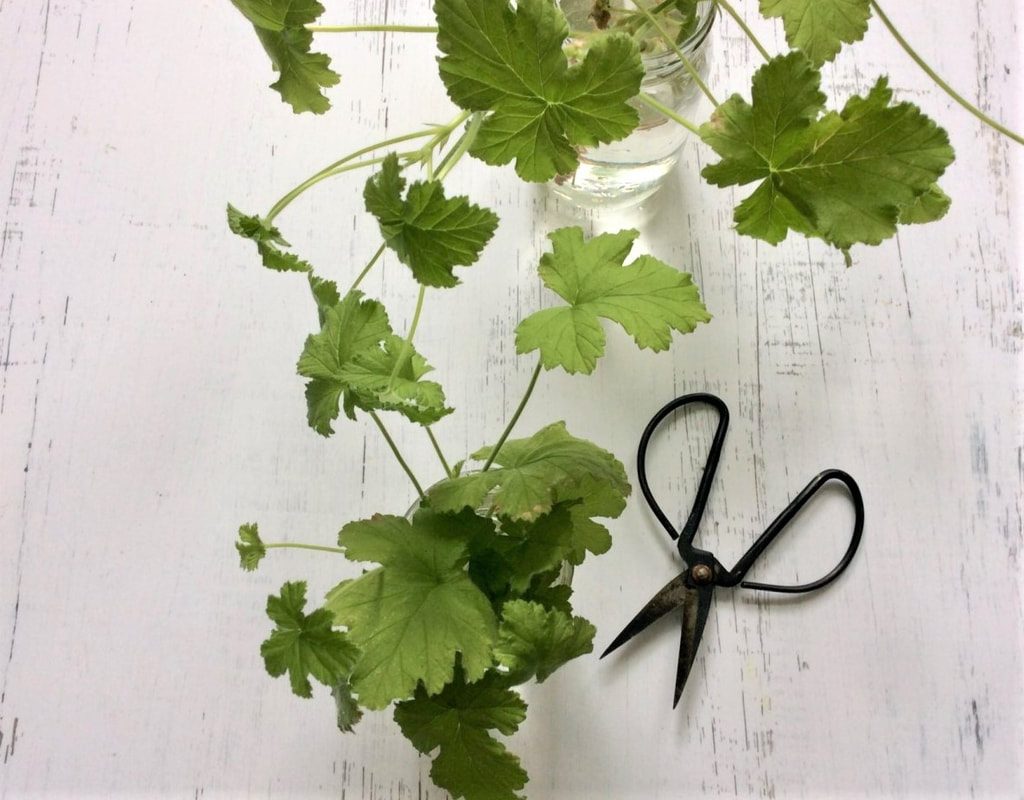
Pelargoniums are easily grown from cuttings two ways: 1) Simply keep your cutting or leaf in a glass of fresh water until roots grow, then transplant to a pot or  2) Dip the cutting in rooting hormone & place in a pot with evenly moist soil. The plants are very long lived & easy to care for-- just be sure to take them back inside before frost if you bring them out for the Summer in Zones under 9. Much like with our heirloom wooly apple-mint, I am all about keeping older & unusual cultivars going & am happy to share! 
Picture
Locals: Seriously, come on it & get a cutting! Just be sure to share the 'G' name you give it with us! :D
Having just given Gerald a major haircut, we have plenty to go around -- if you’d like a cutting, pop on in to the store & I will gladly give you one free of charge! All we ask in return is that you give your plant a name starting with ‘G’ to keep Gerald’s line going! :D  Tag your baby on instagram with #GeraldIsLegion so we cansee your results!
Picture
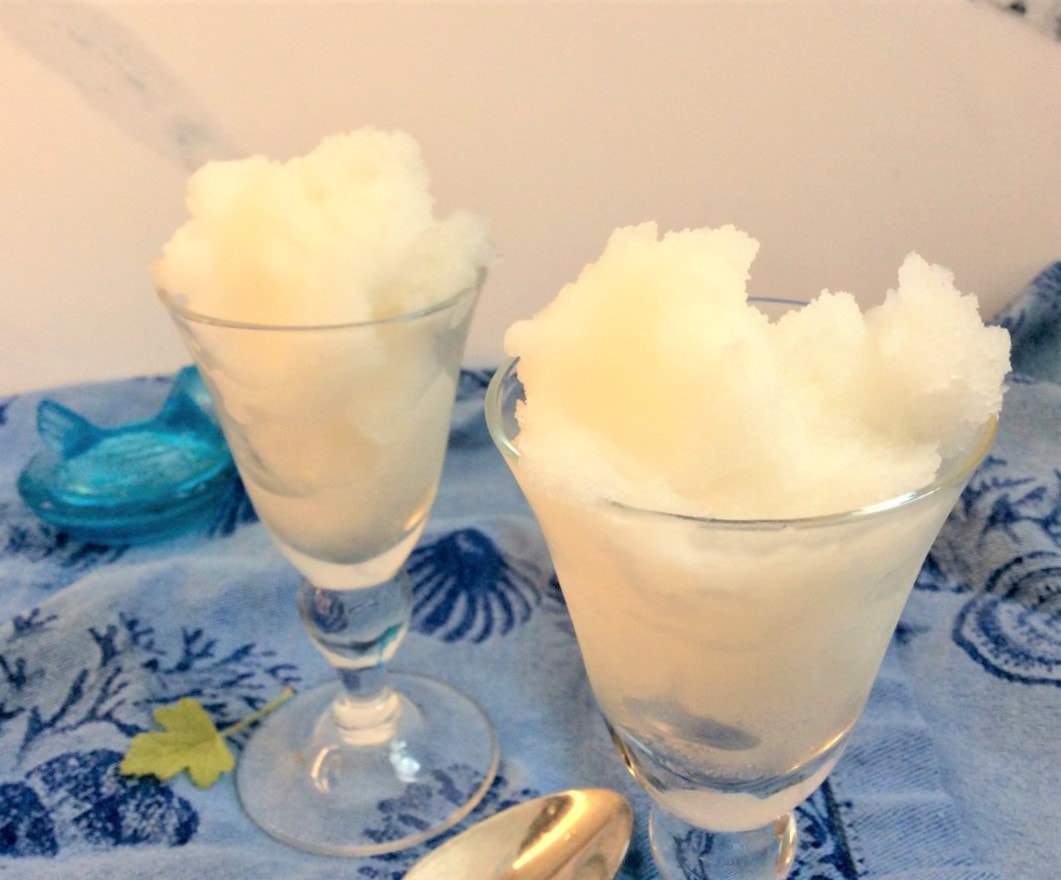
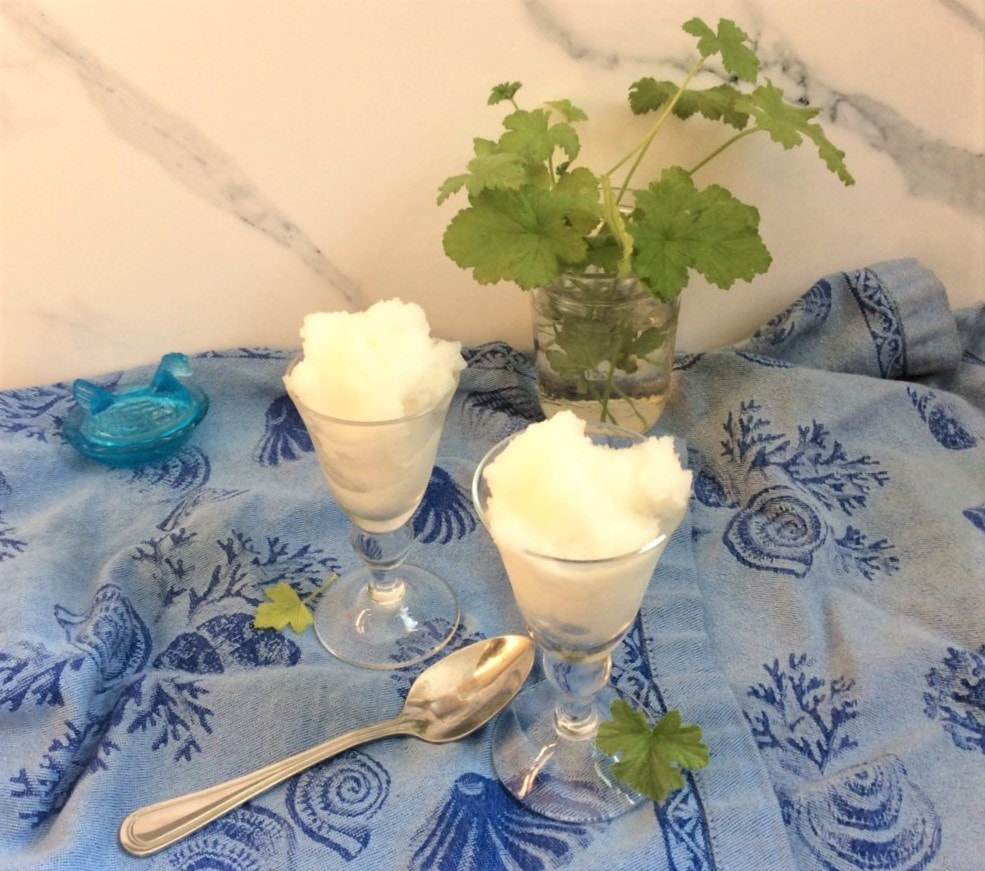
A bit about sorbets before we get into the recipe:  A proper sorbet is delicious! Light & refreshing, these lower-calorie-cousins to ice cream are frequently used as ‘entrements’ or palate cleansers between courses to refresh the mouth, aid digestion, & prevent heartburn. A good sorbet should be smooth, creamy, & easily scoop-able. This is easily achieved at home with a couple of tricks-- First, I add a tiny bit of vodka to mine in order to keep it smooth. That little bit of alcohol prevents ice crystals from forming, as alcohol does not freeze. 
It isn’t mandatory, but consistently helps to provide the best results. I use vodka to avoid affecting the taste. Additionally, you can substitute honey, maple syrup, or agave for the sugar, but it will affect the overall flavor. Second, churning your base really is crucial to achieving the creamy texture we’re after. If you don’t own [or want to own] an ice cream maker, you can use this recipe & freeze your base into granita, which is icier in texture but equally delicious. I will run through ‘No-Churn’ instructions as well. Third, this recipe will make about 3 cups of sorbet, which should be more than enough for 8-10 small servings. It can easily be scaled up if you need, but keep in mind it is meant to be served in small portions. We find it keeps well in the freezer for about a month, staying smooth & easily scoop-able. My final note is that you can absolutely use any scented geranium to flavor your batch. Gerald is not the only game in town in this matter [although he does make an exquisite sorbet!] Okay--Let’s do it!

​Rose-Geranium Sorbet


​1 cup Granulated Sugar 

2 cups Water
Fresh Scented Geranium Leaves, about 25
2 ½ TBS Fresh Lemon Juice
2 TBS Vodka [optional, or 2 TBS more water]
Picture
Picture
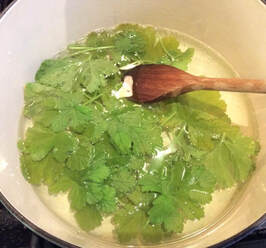
We begin by making geranium syrup for our base. This syrup must be chilled for at least 4 hours before making the sorbet. I like to make mine the night before & refrigerate it overnight. Add the sugar & water to a saucepan over med-high heat. Stir to completely dissolve the sugar, then add your fresh geranium leaves. Bring to a full boil, stirring occasionally. Reduce heat & simmer for about 5 minutes. Remove pan from heat & allow to steep for 10-15 minutes. ​
Pour your syrup through a fine strainer to remove the plant material [which can now be added to your compost.] Once it reaches room temperature, add the lemon juice & vodka [or additional water] to your syrup & place it in the fridge to chill. The colder your base, the better your results will be. Once it is all chilled up properly, it's time to churn it in your ice cream machine or execute the “freezer method” for those without machines.
Picture
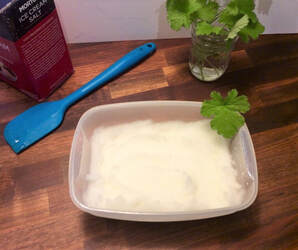
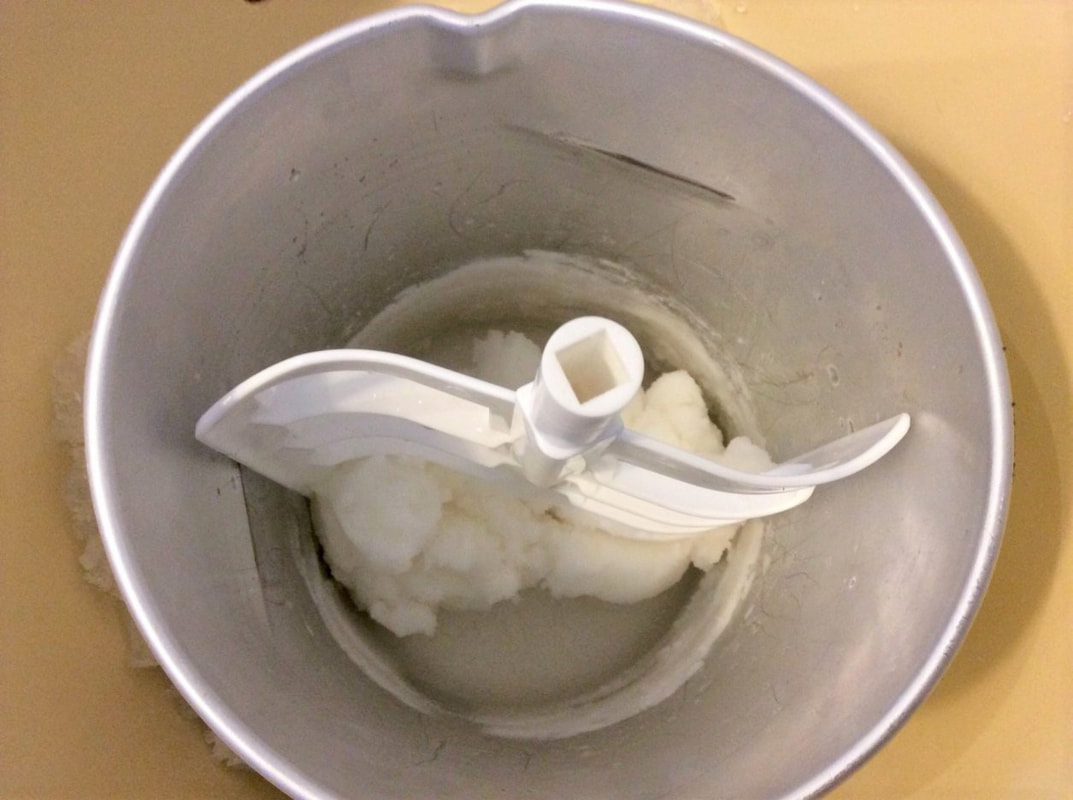
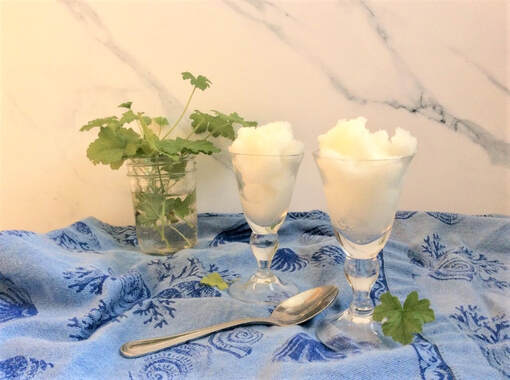
Ice Cream Machine Directions: Add to chilled machine & follow machine directions [about 20-30 minutes usually.]  Scoop into freezer container, smoothing with a spatula. I prefer a long, shallow container so I can get nice curls when serving. ENJOY!
Freezer Method:  Pour base into container, cover & place in your freezer. After a couple hours [semi-solid state,] take it out & hand-churn it up with a fork. Place it back in the freezer. Once it has refrozen, scoop it all out & put it in a blender or food processor. Run it until it is mostly smooth. This version will be more like a granita, icier than true churned sorbet. Cover & refreeze until serving. This version should stay scoop-able for about 3 days. ENJOY!
Picture

Picture

​Wondering what else to make with your delicious Scented Geranium? Give my super easy Geranium Infused Blood Orange Curd a try! 
​You'll be happy you did!
geranium blood orange curd
There it is! I hope you enjoy the post & give this lovely, herbal sorbet a try. This recipe is super-easy to make & always a hit. It is so unusual & elegant. Please let me know what you think if you make it!
I am 100% serious about coming in for free cuttings of Gerald. And about sharing your results with #GeraldIsLegion.  ​This is definitely a cultivar we want to keep around!  
Until next time--Stay safe & remember to  #StopAndEatTheFlowers [or leaves as the case may be!]
1 Comment

Foraging Fun: Evergreens, identification & uses

1/25/2021

0 Comments

 
Picture
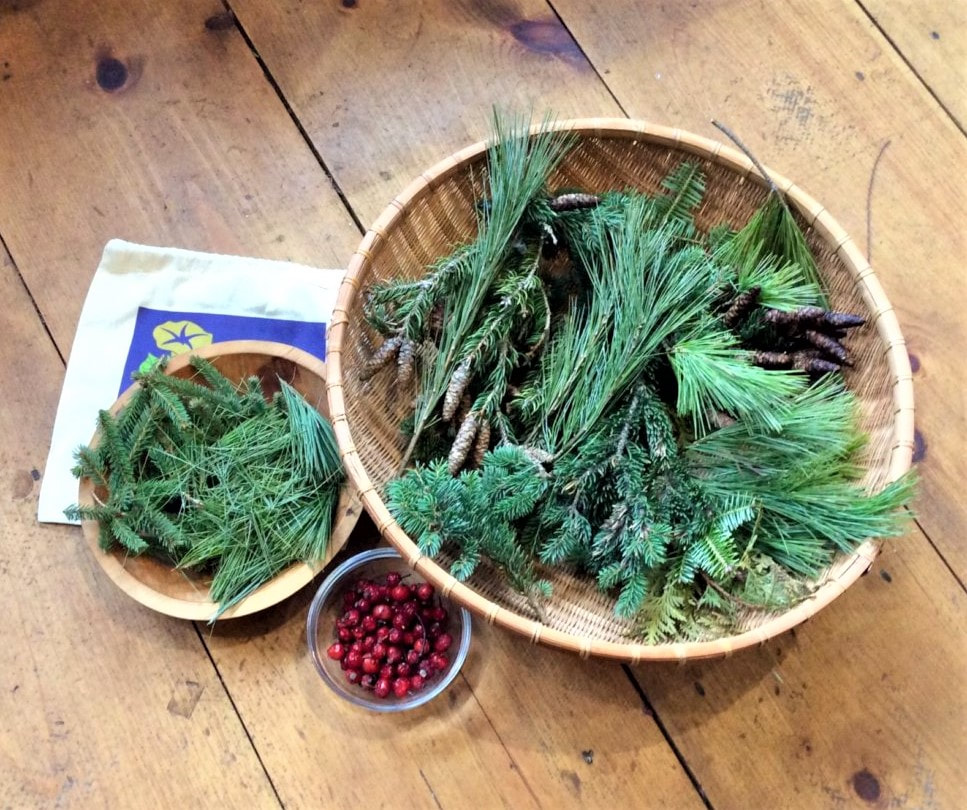
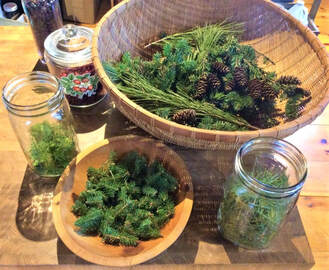
My haul from a Winter foraging walk is mostly evergreens, along with some rosehips.
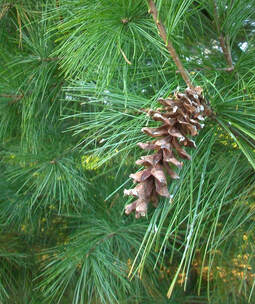
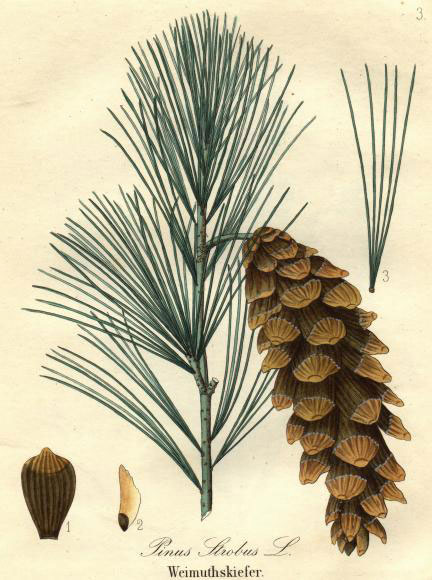
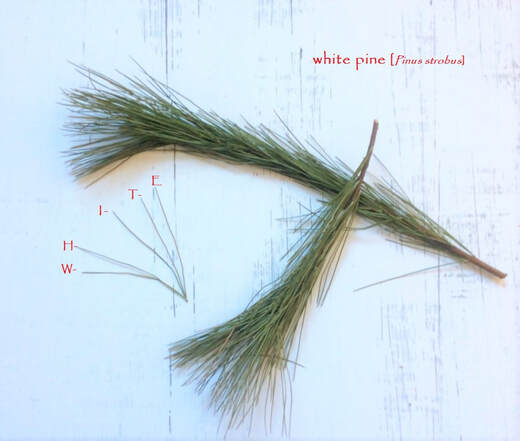
Given we live in Maine, I suppose it isn't surprising I'm passionate about evergreens. I've had a long love-affair especially with White Pines, so it is quite fitting indeed that we live here in the Pine Tree State. It seems a hundred years ago, when my daughters were tiny peanuts, that we would grab baskets & head out into the woods around our log-cabin to gather treasures. How clearly I recall hunkering down & fanning out a freshly picked cluster of White Pine needles to show them the easy 5-needle ID [W-H-I-T-E for White Pine.] <3 
​Memories to cherish.
​
Picture
The Eastern White Pine [Pinus strobus] has coniferous needles which typically grow in bundles of 5
Here in the dead of Winter, our year-round Herbal Allies in the evergreen family are a perfect way to entice yourself to get out into the cold, fresh air!  With so many members & so many edible & medicinal ways to use them, it is hard to know where to start. They have been used in traditional Nordic & Indigenous Peoples cooking for centuries. Loaded with Vitamins C & A, as well as healing & pain-soothing properties, evergreens are main staple plants, especially for winter foraging.
​
Easy to identify & available in nearly every climate, evergreens are a great place to start if you’re new to foraging as well. 
As with any foraging undertaking, it is imperative you accurately identify what you are collecting. Colleen of Grow, Forage, Cook, Ferment has a wonderfully detailed guide to ID-ing conifers that is packed with helpful info. Check it out before you head out!
​And as always, be sure to harvest from more mature trees, steer clear of those sprayed with pesticides or growing close to heavily traffic roads or railroad tracks, & avoid harvesting from the top of the plants, which can stunt their growth. Take only what you will use.
Picture
Most conifer needles are edible, with the exception of the toxic yew [Taxus spp.] tree. Spruce, pine, fir, & redwood all have wonderful herbal & edible uses. Conifer needles are particularly useful in teas & steams, but are also used in applications varying from healing-salves to flavoring infusions. In order to protect the Vitamin C, these needles are often cold-infused. Boiling, or heat infusion will result in less Vitamin C, but a deeper, more intense flavor. Both methods of extraction are used depending on the desired result. I love to add spruce tips to my daily tea where flavor, not vitamins, are my main focus.

Picture
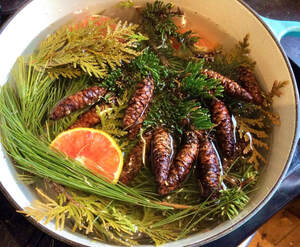
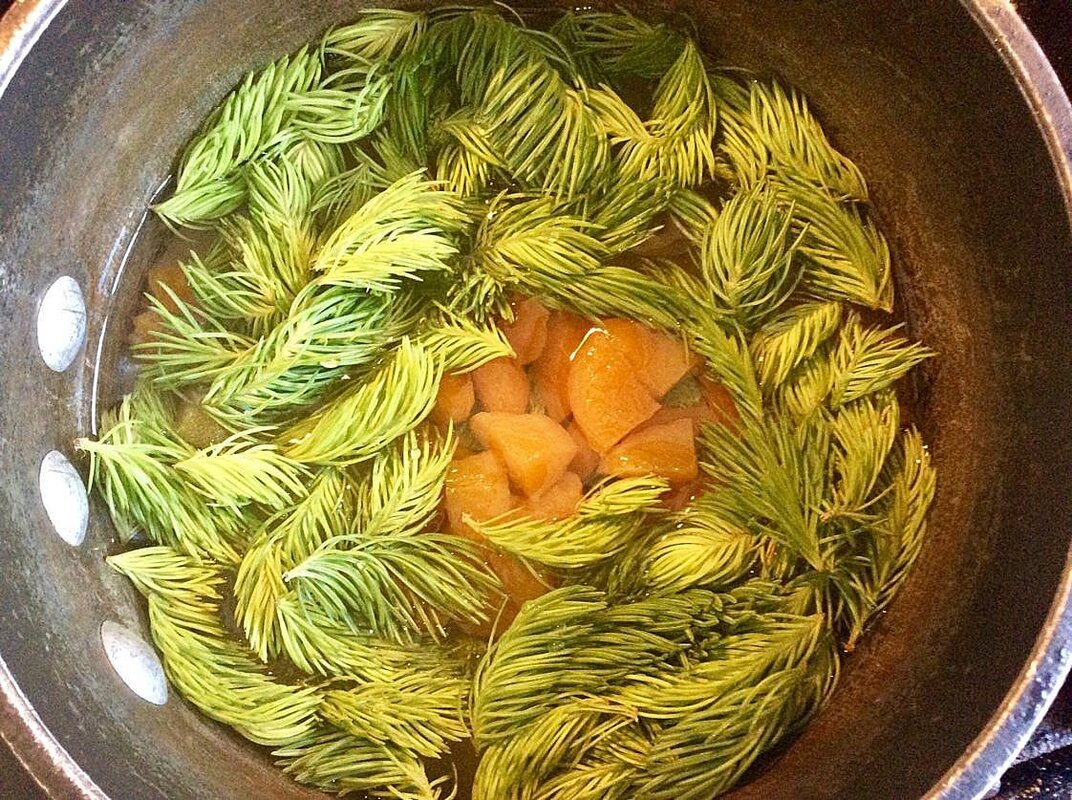
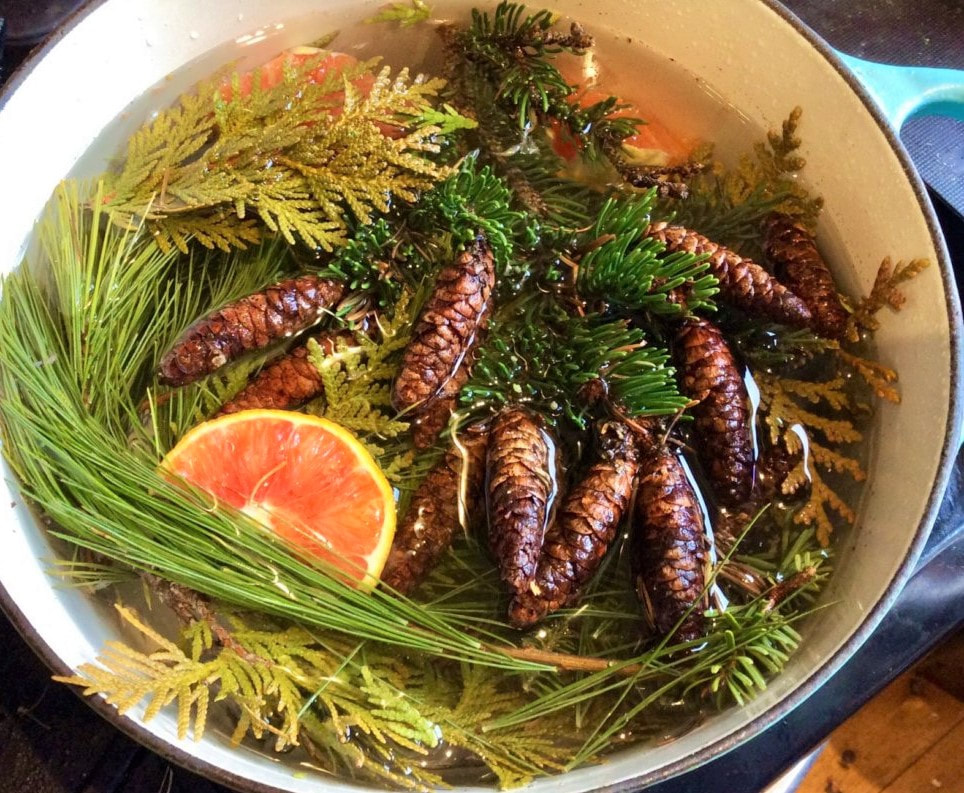
Stovetop potpourri of foraged evergreens with oranges rejuvenates me & my home!
A favorite way to use freshly gathered evergreens is in fragrant stovetop potpourri. This is a wonderful way to freshen stale air in your Winter-locked-down home, as well as to freshen your spirits! Grab a nice selection of evergreens -- my pot here includes White Pine, spruce, fir, & cedar branches & pinecones, along with a few slices of orange. Pop them in a large, heavy pot & cover with water by about 1”. Set the pot on your stovetop on high heat & bring to a boil. Lower the heat to maintain a slow simmer as long as desired, adding more water if needed, as you diffuse the fresh scent through your home & add moisture to the dry Winter air. Heavenly!
Bring the scent of evergreen's into your home

Maine Woods Soap

Spiced Pine Botanical Candle in Scotch Glass

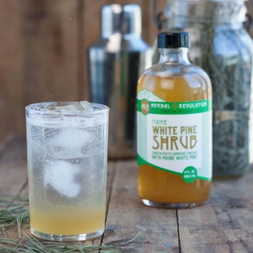
White Pine Shrub, Herbal Revolution

Botanical Travel Tin Candles, 4 oz size

Hand-Tied Herbal Smudge Sticks

Sold out

Cedar Botanical Candle in Scotch Glass


​A
nother super easy way to enjoy the benefits of pine is to add fresh needles to some
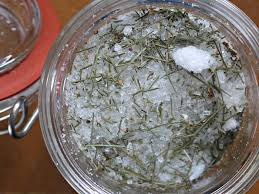
bath salts for a fragrant, detoxifying soak. You can use whatever type of bath salt you have on hand, Epsom salts & pink Himalayan are two of my favorites. Simply snip your freshly gathered needles into small pieces. Add them to a jar with your salts & some sweet almond or olive oil [about 2 TBS oil per 3 cups salt] & shake to 
Picture
Fresh Pine Bath Salts Are An Easy Treat To Make
combine. Allow to infuse for at least an hour before use--but this mixture will keep for a couple of months. If you have them, crushed juniper berries are a lovely addition to this soak, or even a few drops of cypress, orange, &/or cedarwood essential oils [up to 12 drops total per 3 cups of salt.]  Incredibly soothing for the mind & the body, this soak is a Wintertime must! Be sure to place a small strainer or piece of cheesecloth over your drain at the end to catch the plant material when draining, or place your salts in a bath infuser or muslin bath-bag to start with.
Picture
Sorting & drying my herbs to enjoy in tea year-round.
Spruce is an absolute favorite of mine for flavoring syrups & teas, as well as for infusing in gin. Tender, young spruce tips in the Spring give the very best flavor, but spruce needles can be used this way year-round with wonderful effect. I will do a drink focus with them this Spring, showing a favorite pairing of them with apricot. You can easily find recipes online to make Spruce Tip Beer as well --although I have never played with this, I have heard wonderful things about it!  
In the Winter, I tend to favor teas with spruce, adding tiny cuttings to my herbal tea blends almost daily. I have also been playing around with them in a zero-proof ‘gin’ alternative with very positive results, but that is also a post for another time.
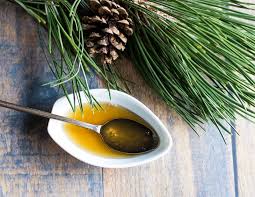
​Finally, I will mention the use of Pine in cough syrups. White Pine particularly is wonderful for soothing sore throats & works well as an expectorant. I will refer you back to Colleen’s Grow, Forage, Cook, Ferment for a wonderful Pine Needle Cough Syrup recipe. It is thoughtfully detailed & presented in her post & definitely worth your time to make.
Picture
Check out growforagecookfement for a lovely pine cough syrup recipe
I hope you have enjoyed this post & that it has encouraged you to get out & enjoy the outdoors during this slower-paced time of year. There is always something to learn & something to do in the Herbal World. If you are just beginning to explore foraging, evergreens are a wonderful [& delicious] starting point.
Let me know what you are foraging & how you are using it-- I love to hear from you!

Until next time--Stay safe & remember to  #StopAndEatTheFlowers 
0 Comments

Herbal Spotlight: Butterfly Pea Flowers with Winter Blues Pie Recipe

1/12/2021

0 Comments

 
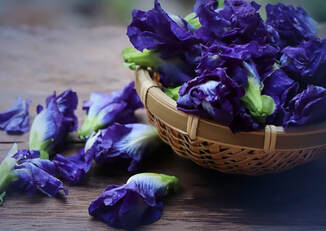
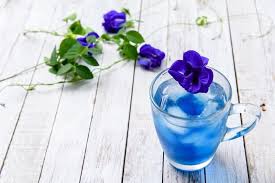
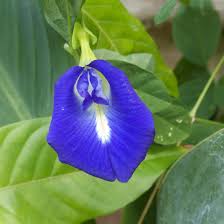
Butterfly Pea Flowers [Clitoria ternatea] provide gorgeous natural color, as well as many benefits for the mind & body.
Trade your
Winter Blues for some natural Botanical Blue & brighten things up as we explore these amazing flowers & their benefits-- & have some fun playing with them in a recipe for a blue rice & custard pie too!
Picture
Picture
Adaptogens are substances that are considered to help the body resist stressors of all kinds, whether physical, chemical or biological, and to exert a normalizing effect upon bodily processes.
More than just a pretty face, Butterfly Pea flowers are a powerful Herbal Ally! Native to Southeast Asia, these flowers have been used for centuries as a memory enhancer, brain booster, anti-stress & calmative agent; they are staples of Chinese & Ayurvedic medicine. Clitoria ternatea are considered to be adaptogenic.  They are packed full of antioxidants, flavonoids,& peptides, as well as anti-inflammatory compounds, particularly anthocyanin, which are believed to support ​
cardiovascular health. They are also traditionally used cosmetically to stimulate hair growth, & to support glowing skin & graceful ageing. ​
Try them yourself in these popular products

Brow & Lash Serum With Wild-Foraged Horsetail

Shop

Organic Butterfly Pea Flowers, Hand Foraged

Shop

Stimulating SLS-Free Shampoo Bars

Shop
Butterfly pea flowers are most often used as a tea & have an earthy-green flavor similar to that of green tea. The dried flowers, when steeped, release a deep indigo-blue color. Due to this, they are often used as a natural food coloring agent in Malasian, Thai, & Burmese cooking. Most interestingly, this color is pH sensitive, producing a wide variety of shades ranging from fuchsia to bright blue-green as it is exposed to different ingredient’s pHs! 
Picture
Image: Ama Grow. pinterest.com/pin/778770960548743102/
Picture
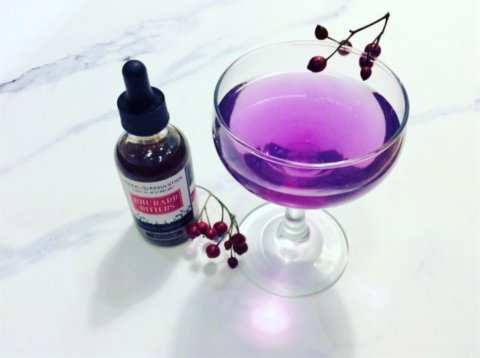
My 'Comfort & Joy' Adaptogenic Zero-Proof Cocktail

​This makes the herb VERY popular for cocktails! As anyone who knows me would expect, I have had quite a ball playing with the effects: Delighting my niece Phoebe [missing you peanut!] with “Electric Lemonades'' & also using them as an ingredient in one of the Adaptogenic Zero-Proof Cocktails I crafted for the Rocky Horror Picture Show at Cupacity last October being two of my favorites. 
BUT, as butterfly pea flowers are most often used for drinks, I decided to present you with a non-beverage recipe in this post, instead sharing a recipe for a wild-looking rice custard pie with rose & cardamom. It is super-easy to make, absolutely delicious, & outrageously colored! Seriously, you will not believe it is achieved with a natural colorant when you see it-- the color is not properly captured by my pictures!
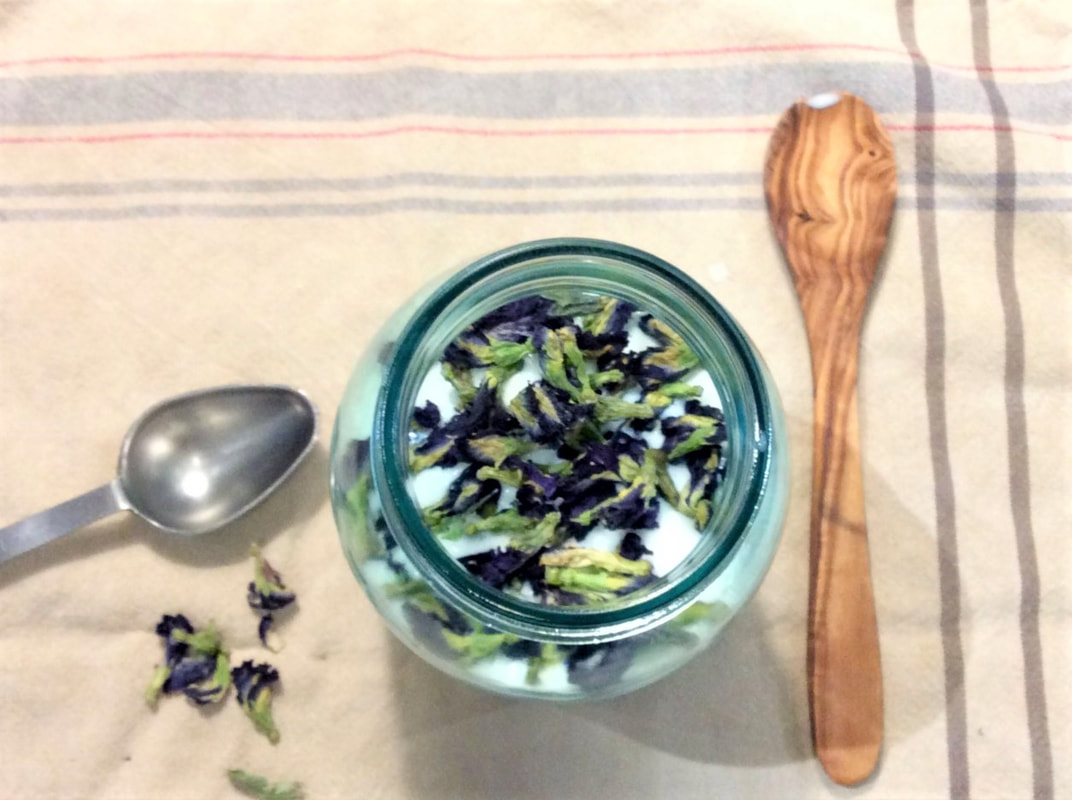
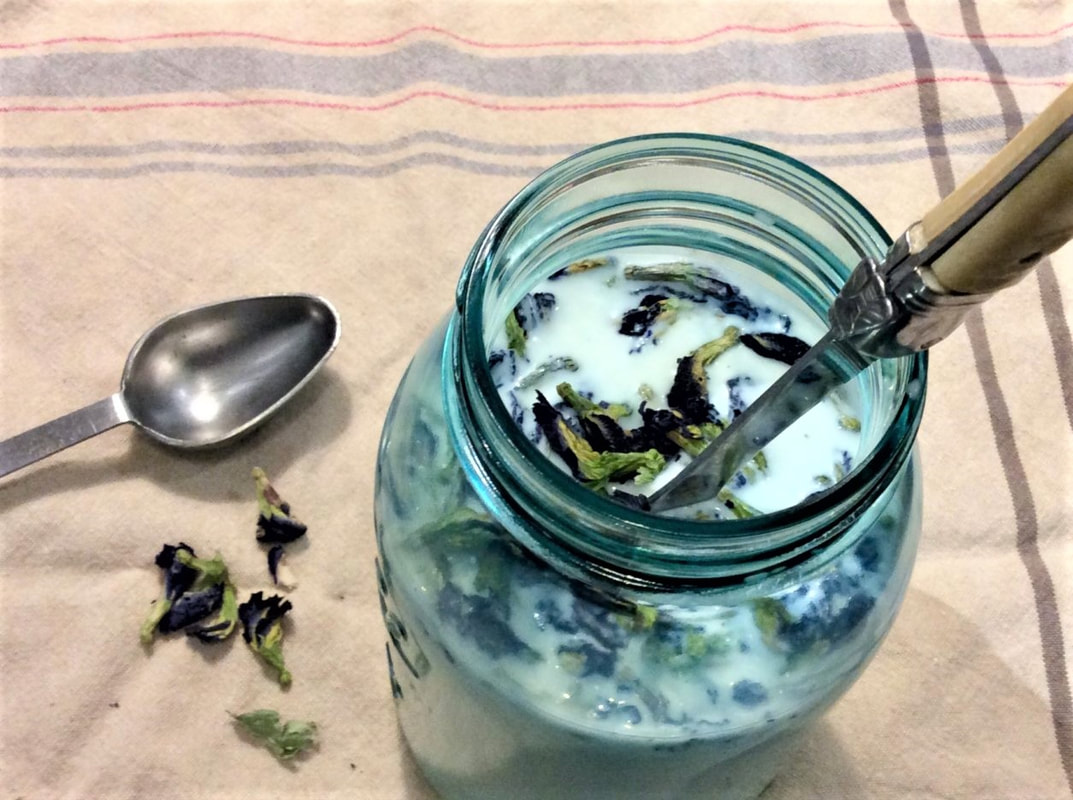
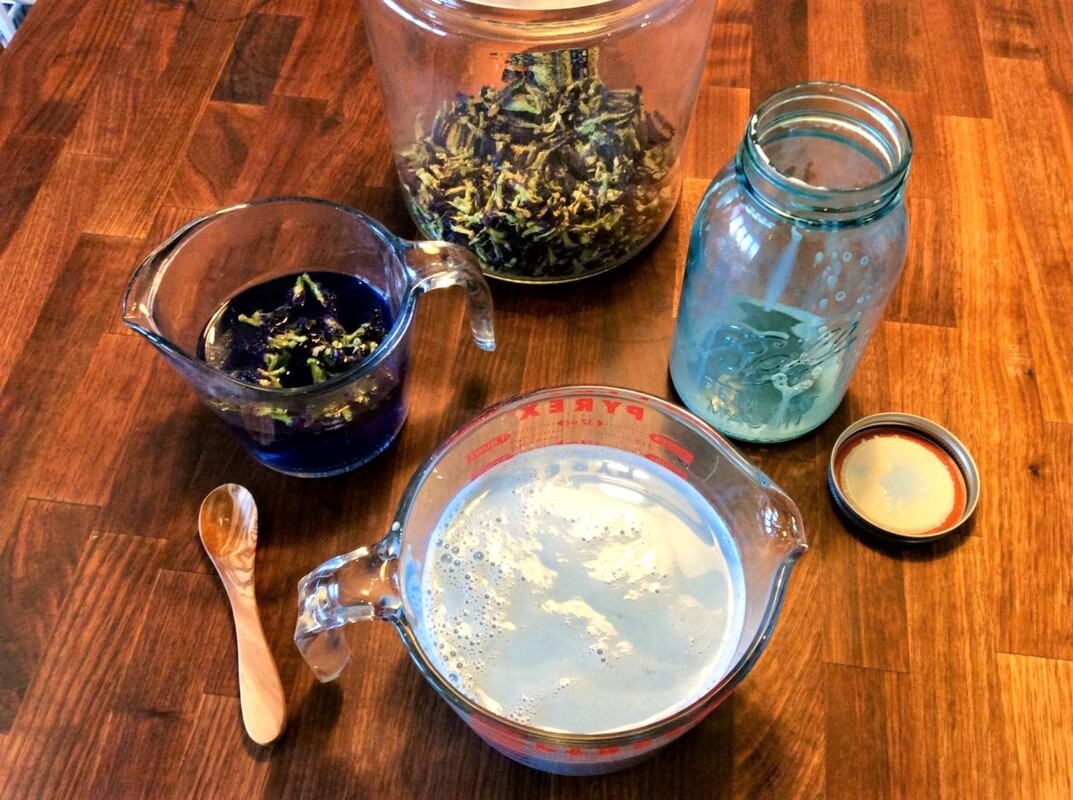
Before we get going, just a few little things: With this recipe, I was aiming for an aqua shade & based my recipe amounts for the herb on this. The more butterfly pea flower you use & the longer you steep it, the deeper shade of blue you will get. I prefer to steep my milk & half & half overnight the day before baking, but you can get away with steeping it for 2 hours or so or even heat it with the dried flowers to color it instead. Additionally, if you say add lemon juice to the rice when it's cooking-- the pH change 
Picture
Steeping my milk overnight
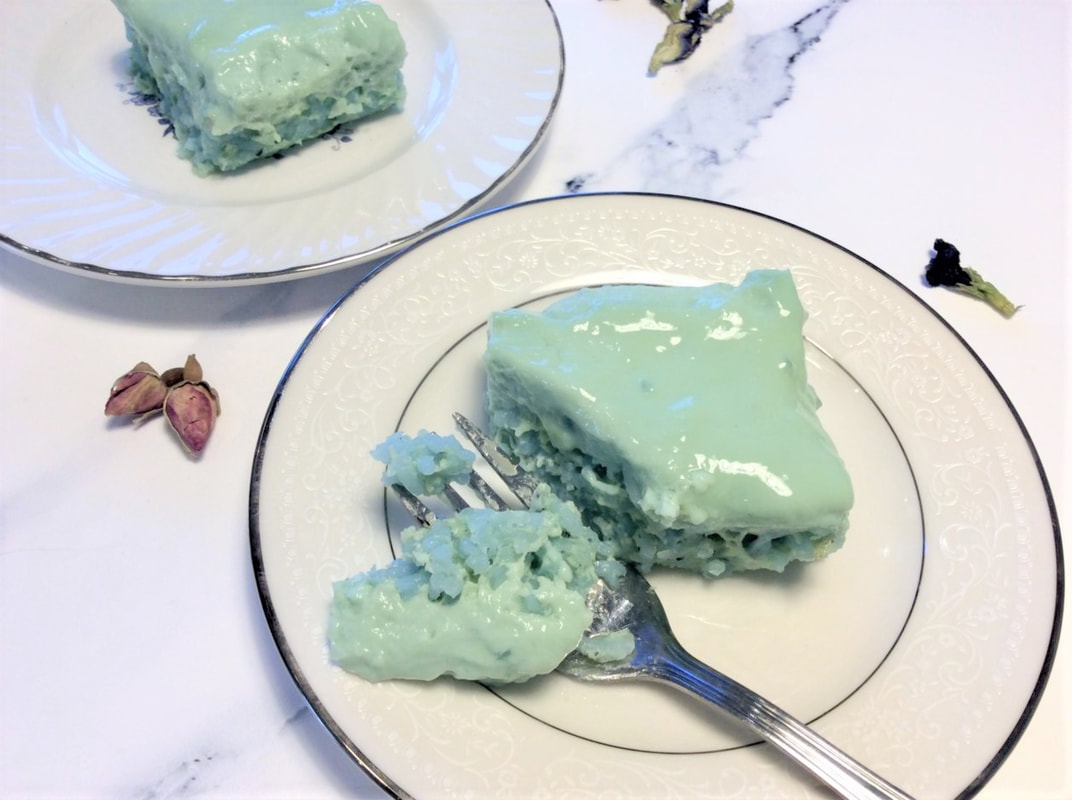
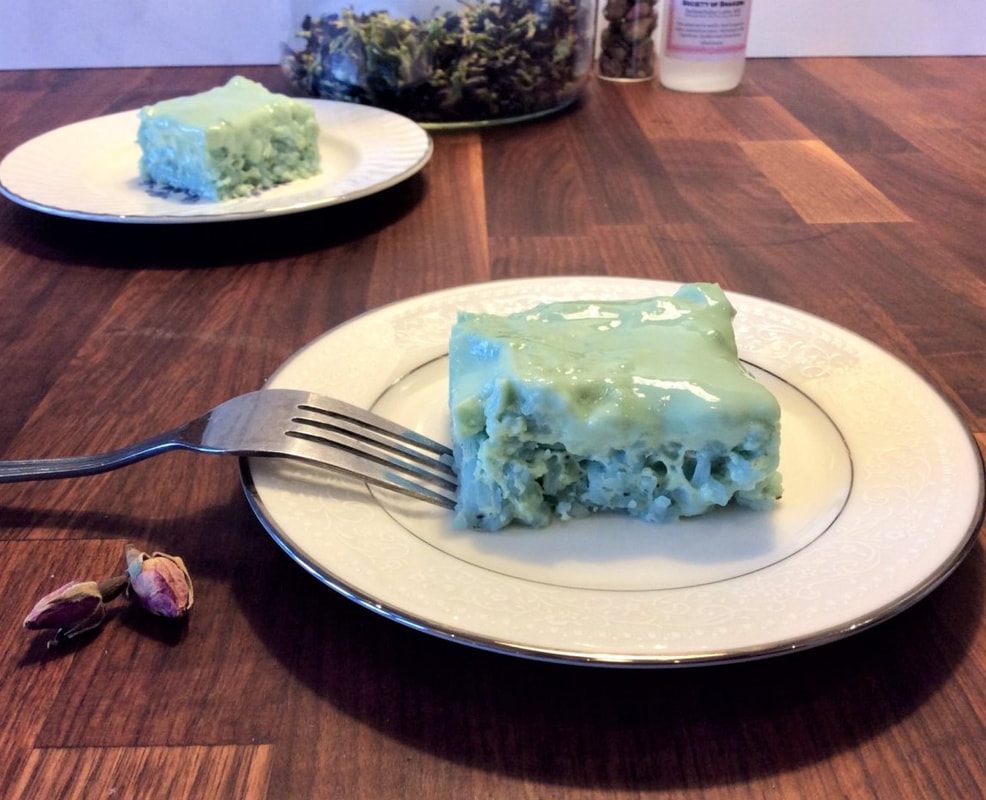
will shift your color to a vivid pink, SO there are endless ways to play with this. Finally, this rice custard pie is a sliceable dessert, served more like brownies than traditional pie. When baked, the rice settles to the bottom with the custard layer forming the top. It is delicious served warm, but many people prefer to chill it in the fridge before serving. The custard top, like all puddings & custard, will form a ‘skin’ which will oxidize & darken. Personally, I prefer to peel it off before serving to better enjoy the color effect of the butterfly pea in it. Here we go!

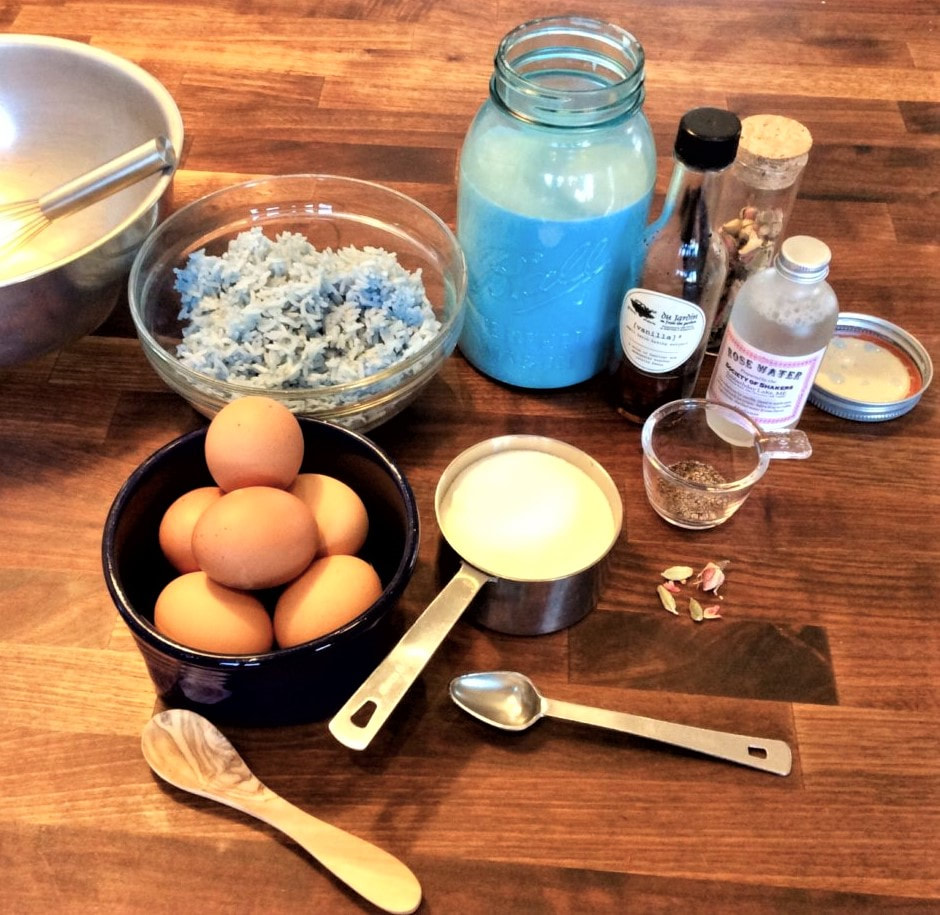
Winter Blues Pie

3 TBS Dried Butterfly Pea Flowers  
2 Cups Milk [whole, skim, your choice] 
1 Cup Half & Half 
1 Cup White Rice 6 Large Eggs 
¾ Cup Sugar 
1 TBS Vanilla Extract 
½ Teaspoon Cardamom Extract [or 1 tsp ground cardamom] 
½ - 1 Teaspoon Rosewater  [to your taste]
Pinch of Sea Salt
DAY BEFORE: Add 2 tablespoons of dried butterfly pea flowers to a quart jar & add the milk & half & half. Pop it in the fridge to steep overnight. Swirling/shaking occasionally.
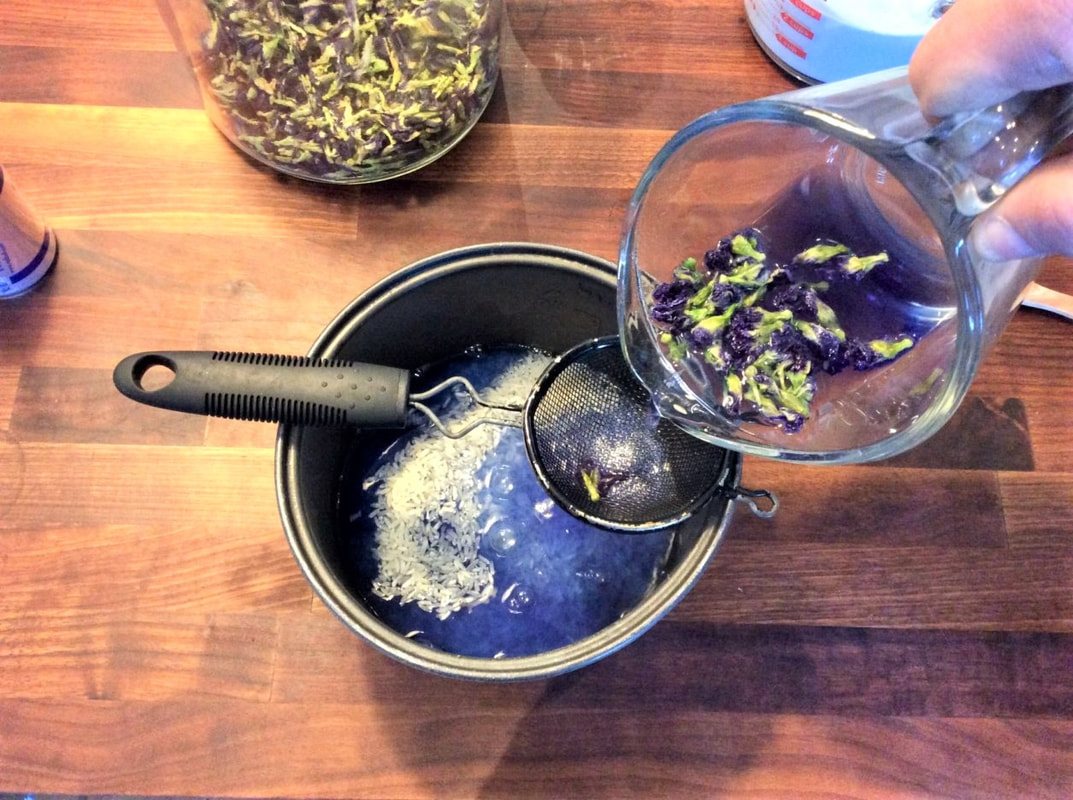
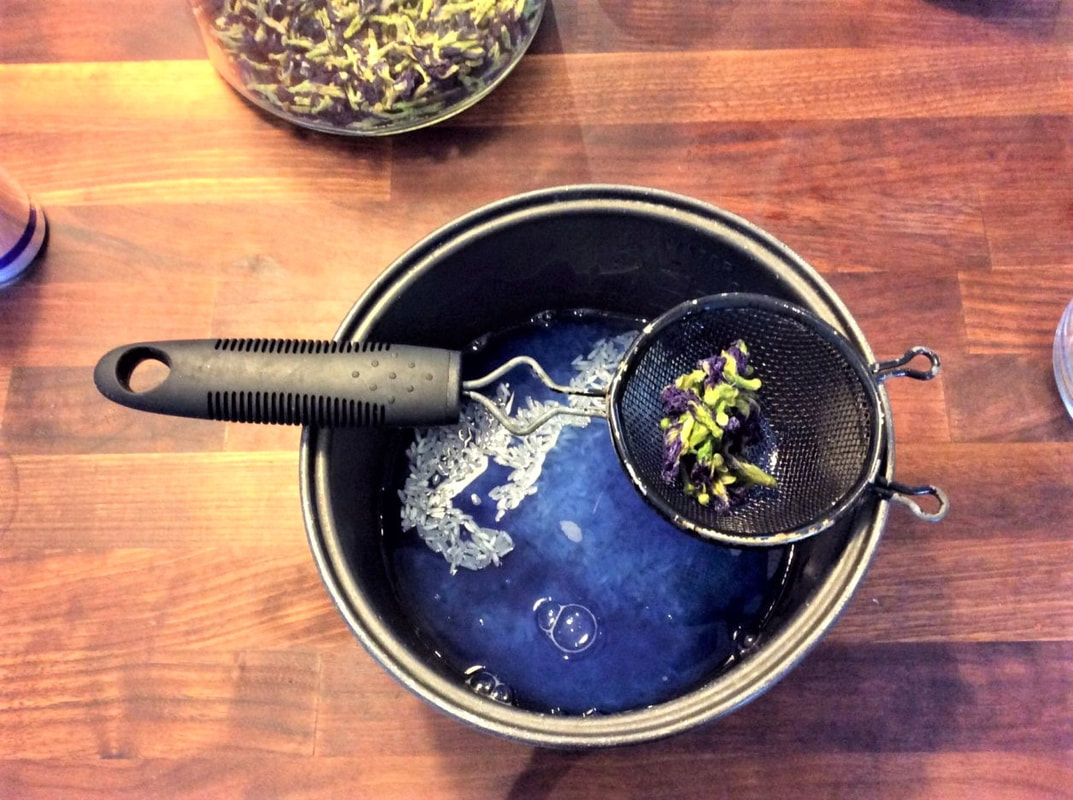
DAY OF BAKING: I like to cook my rice in a rice-cooker, but stovetop is just fine as well. Measure out 1 ½ cups boiling water into a liquid measuring cup, add 1 TBS butterfly pea flowers & stir. Allow it to steep to develop the desired shade of deep blue. I let mine go about 5 minutes to give you an idea. Strain out the flowers & throw them in your compost. Use your blue water to cook your cup of rice, then set it aside to cool. Meanwhile, strain your milk/half & half combo, & prepare your other ingredients. Preheat your oven to 350. Grease an 8” x 8” pan.  Beat your eggs with the sugar. Add your blue milk & flavorings mixing until smooth & completely combined. Stir in the rice, breaking up any clumps. Pour into the prepared baking pan. Bake until a butter knife inserted in the center comes out clean, about 30 - 40 minutes. It is easy to scorch the bottom, so do the knife check even if it still looks loose! Remove from oven. Slice into squares & enjoy! You can serve it warm or allow to cool & chill it in the fridge before serving. Again, I like to remove the top skin before serving.
Picture
Images do not properly capture the strange shade of aqua here!

​And there you have it -- a violently un-natural looking naturally colored dessert! Sure to thrill the child [or child-at-heart] in your life. The blue milk is particularly fun for Star Wars fans [on its own or baked into this dessert]  I like the blue-blue of doing it this way, but adding an acid to the rice would make it more pink-purple & give interesting tonal coloration. The color shift is really fun to play with! 
​
More than just the sheer strangeness of the colors, remember you are getting the herbal benefits of the butterfly pea flowers. This Herbal Ally provides so many benefits for mind & body. It is definitely worth adding to your own tea selection or Herbal Apothecary. 
I hope you enjoyed this look at these amazing flowers & this silly-fun recipe. It is likely I will post some drink recipes made with this herb in the future too. Let me know how you like to use Butterfly Pea & what color combo you create! Check out our very special skin & hair care products crafted with this Herbal Ally.  
Until next time--Stay safe &  #StopAndEatTheFlowers 
0 Comments

Foraging-Fun Recipe: Easy Rosehip Marmalade

12/28/2020

2 Comments

 
Picture
Rosehips are one of the stars of Winter Foraging here in Maine for sure. There are so many ways to enjoy them, from simply drying them for tea, to turning them into cordials & jellies, but Rosehip Marmalade is always at the top of the list in this house! In this post, I will share my super-easy, 4-Ingredient, Pectin-Free recipe & you can see for yourself why! All you need is sugar, 5 oranges, 1 lemon, & rosehips!
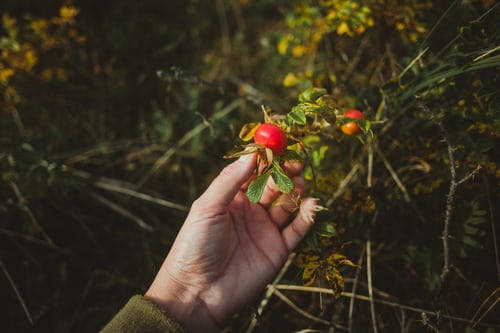
Rosehips, for those not familiar with them, are the fruit of the rose plant. Packed with Vitamin C & nutrients, rose hips are valuable commodities. Press them for oil to nourish & brighten the skin. 
All roses & their hips are edible, with the smaller hips of wild briar-roses having the strongest flavor. The flavor of rosehips is wonderfully enhanced & complimented by citrus, making them ideal for use in marmalade. The cleaning & preparing of rosehips for use in jelly or marmalade is a labor of love, but worth the effort for the benefits & flavor they provide. I personally find marmalade best crafted with the hips of the gorgeous, wild beach roses [Rosa rugosa] covering the coast here in mid-coast Maine. 
Picture
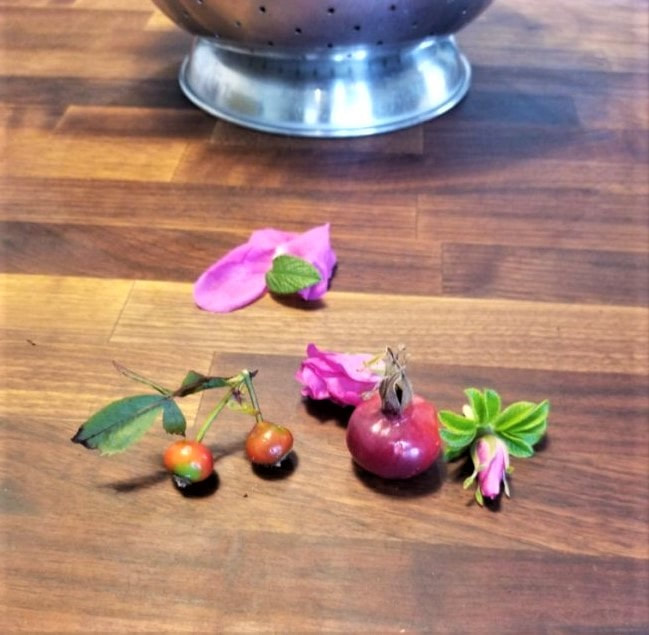
Wild Briar-Rose hips on the left VS. the enormous hips of the Beach Roses on the right!
Find Rose Hips In These Products of Ours

Tiger Grass Skin Barrier Recovery Serum With Rice Ceramides

Shop

Hibiscus Lift Tea

Shop

Blue Tansy Brightening Face Serum With Wild-Foraged Self Heal

Shop

Botanical Bliss Adaptogenic Herbal Tea With Tulsi & Butterfly Pea Flower

Shop

Elderberry Refining Velvet Day Balm

Shop
Rosehips are traditionally used to support the immune system, ease arthritis pain, & provide antioxidants. I begin harvesting rosehips after the first frost each year for best flavor. Inevitably, as the birds, deer & other foragers take their share, the available numbers begin to dwindle, although if you are diligent & persistent, you can find usable hips all through the Winter.
​[as always, 
be very careful to only harvest from plants that have not been treated with pesticides.]
Our Beach Roses make enormous, cherry-tomato sized hips, which are much easier to clean & prepare. Again, any rosehips can be used for this recipe; I simply prefer to use the jumbo hips of Rosa rugosa myself.  Late December - January, when the Cara Cara oranges arrive & citrus season is in full-swing, is THE time to make this treat.
Picture
Some of last year's haul--Note that gorgeous color from the Cara Cara oranges!
Before we get going, I have a few tips about making marmalades. First, as we are using the entire orange in our recipe, I recommend only using organic oranges here. Any variety oranges can be used, but with their vibrant color & unique flavor, Cara Caras are my favorite. Additionally, they are a seedless variety, which makes them even easier to use. They certainly make the prettiest marmalade you have ever seen too! Citrus peels contain a ton of natural pectin, so no store-bought pectin is needed at all for this recipe! It is important to cook the oranges until the peels are very soft in the first stage of this recipe, as they will firm up a bit when the bulk of the sugar is added. Also, be sure to use a large pot as marmalade needs lots of room to cook!  
Finally, watch the color of your marmalade as you cook-- If it begins to turn brown that means the sugars are caramelizing & you are overcooking. Quickly remove it from heat if you notice this happening. 
​Okay, grab some clean jelly-jars & your thermometer & let’s get started!

Easy Rosehip Marmalade

4 cups Rosehips, cleaned & trimmed [roughly]  
4 ¾ cups Sugar  
2 Organic Cara Cara Oranges, thinly sliced  
3 Cara Cara Oranges, juiced  
1 Lemon, Juiced
Prep your jelly jars & lids, & have your thermometer handy. Start by cleaning your rosehips, removing the seeds & tiny hairs inside each hip. This is the work part of the marmalade--seriously! Once this task is completed it is SUPER EASY so do not be discouraged! The blade of a small paring knife or tip of a vegetable peeler will help speed this along. Place your cleaned hips in a colander & flush them with cold running water for a minute or 2. To extract the juice from the hips, place them in a coquette or large stock pot & cover with 1” of water. AVOID the use of aluminum pots or utensils as they will damage the Vitamin C in your rosehips.  
Picture
Here I have removed a big bag of Rosa rugosa hips from my freezer to thaw & clean for a batch
Picture
Bring to a boil, then simmer for 30-60 minutes until rosehips are soft & easily smashed with the back of a wooden spoon. Run the rosehips & all the liquid through a jelly bag, food-mill, or fine strainer to separate any stowaway seeds & pesky hairs along with the skins. [Pop that lot into your compost.]
​ You should be left with cloudy, red-orange rosehip juice! Set it aside to cool.
Thinly slice your 2 oranges with a sharp knife or mandoline, then cut the slices into quarters. [this is so you end up with nice bite-sized pieces of peel in the end!] Add the sliced oranges & any juice they let out to the now-empty pot, along with 1 cup of sugar & the juice from the other 3 oranges. Bring this to a boil. Once a full boil is reached, reduce your heat & simmer until the peels become soft & translucent, roughly 30 minutes, stirring occasionally. You may need to add a bit of water to keep the simmer going, but the juice is usually sufficient. 
Picture
Picture
​Once the peels are translucent, you are almost done! Add your rosehip liquid, the lemon juice, & all the remaining sugar. Stirring constantly, bring it to a boil & start checking your thermometer -- It is very easy to scorch or overcook marmalade! It is ready once it is between 219 F - 222 F, depending on how firm you like it. I generally strive for the middle ground of 221 F. Remove your pot from heat & quickly ladle your marmalade into your waiting jars. Voila! Gorgeous & delicious marmalade! You can either keep your jars in the fridge or process them in a water canning bath for the proper length of time for your elevation.
This marmalade is absolutely delicious & pairs well with sweet or savory items. Equally lovely with roast meats as with butter on toast, or paired with a sharp cheese. Clever April from SugarSpell Sweets treated me to an amazing cake last January that she filled with this marmalade [she also brushed the cake with my Rosehip cordial <3] that was outrageously good -- the possibilities are endless & your body will thank you for the loads of Vitamin C! I do hope you enjoy this recipe--Let me know how it turns out for you & how you like to use it! Until next time--Stay safe &  #StopAndEatTheFlowers 
2 Comments

Herbal Spotlight: Bergamot & My Earl Grey Cordial Recipe

12/14/2020

1 Comment

 
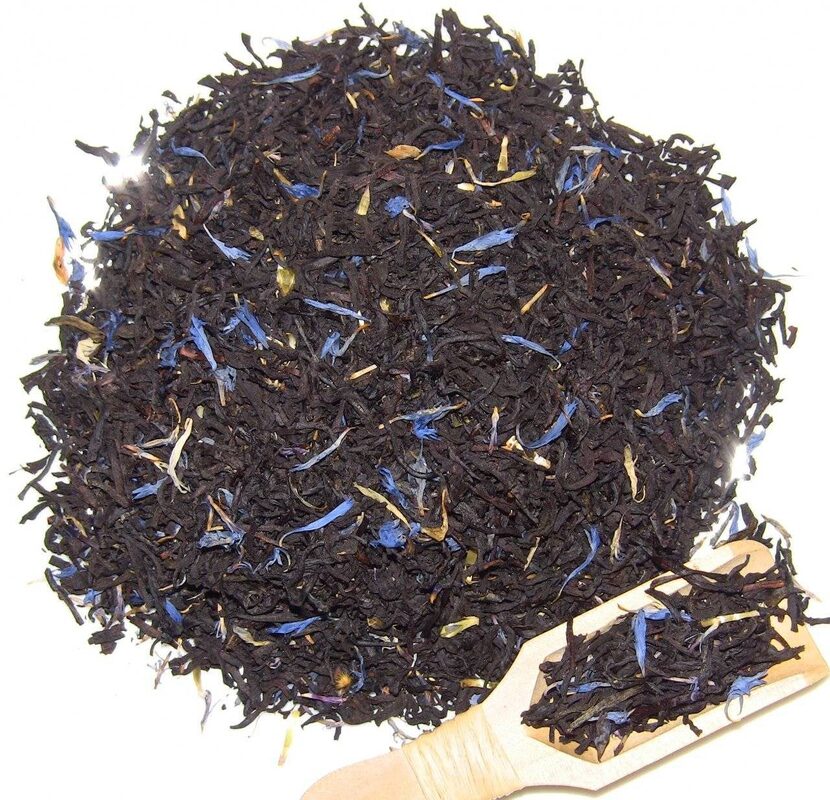
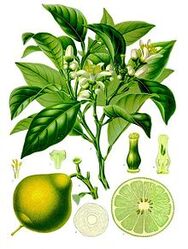
With its bright, uplifting notes of Bergamot, Earl Grey tea has been a favorite of mine since I was a little girl. Earl Grey is a tea blend which has been flavored with the addition of oil of Bergamot. The rind's fragrant oil is added to black tea to give Earl Grey its unique taste, as well as much of its ‘bounce!’ Bergamot are yellow or green citrus fruit that have been used culinarily & medicinally for centuries. Essential oil of Bergamot, expressed from the peel, has the unique ability to be both calming & uplifting at the same time, & has traditionally been used to help with anxiety & stress. 

Picture
Image By David Dewitt: thecozycoffee.com/english-breakfast-vs-earl-grey
Picture
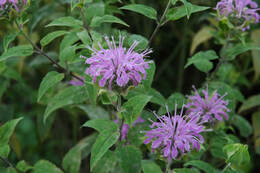
Photo: extension.umd.edu
Side Note:  Despite featuring a very similar scent & flavor, the herb known as Wild Bergamot [Monarda fistulosa] is completely unrelated & is actually part of the mint family -- although it was steeped as tea by colonists missing their Earl Grey here in New England during the Revolutionary War!
I adore the scent of Bergamot as well as the flavor!  Indeed, you'll find her in many of our best-sellers, including these items:

Botanical Body Oil, Moss & Fern

Rose Gold Luminous Face Serum

Jasmine Radiance Herbal Mist

Moss & Fern Artisanal Soap

Moss & Fern Perfume Oil

Botanical Body Oil, BRIGHT

I enjoy the taste of Earl Grey many different ways, but one of my favorites is as a cordial, both on its own & as an ingredient in craft-cocktails. It is very easy to brew up & makes a lovely gift as well! This recipe has two parts: the initial alcohol extraction, & then, weeks later, the tempering & sweetening of your tannin-filled base. Part One should infuse for 2-4 weeks to extract as much flavor as possible. 
Picture
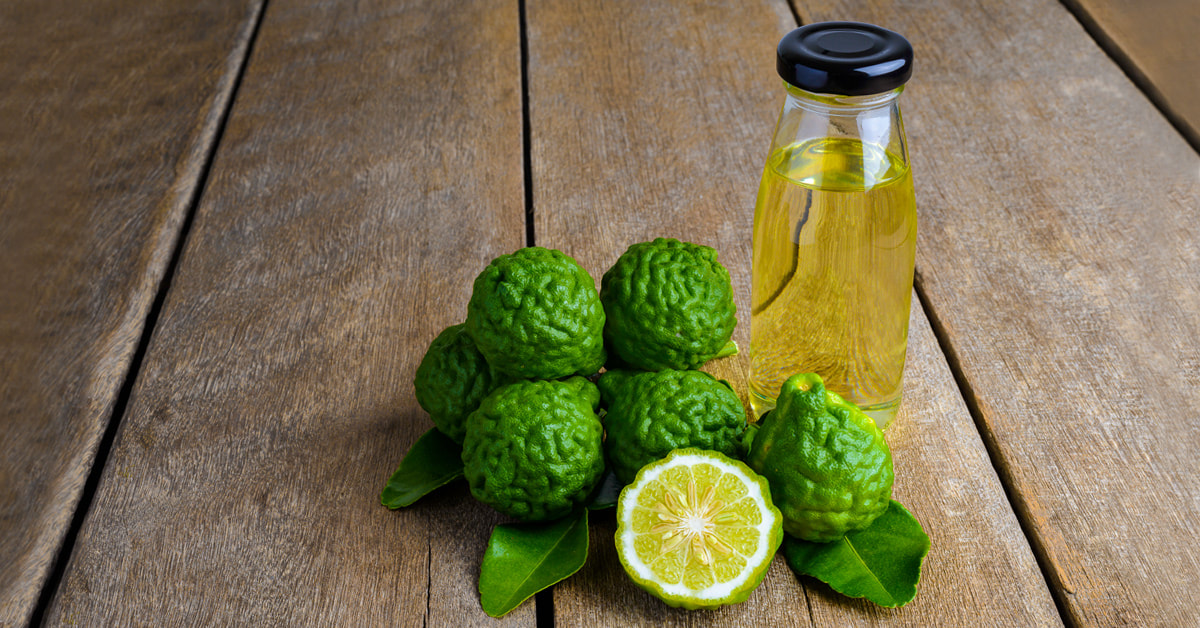
Bergamot oil is expressed from the green or yellow peel of the fruits.
Picture
I highly recommend using loose-leaf tea for this recipe. The leaves within pre-packaged tea-bags are most often pulverized to fine dust & do not hold as much flavor. If you only have bagged on hand, be sure to remove the bags, strings, & staples before brewing, & use a bit more. In this post, I will run through making the cordial, as well as a recipe for a fun craft-cocktail to make with it!

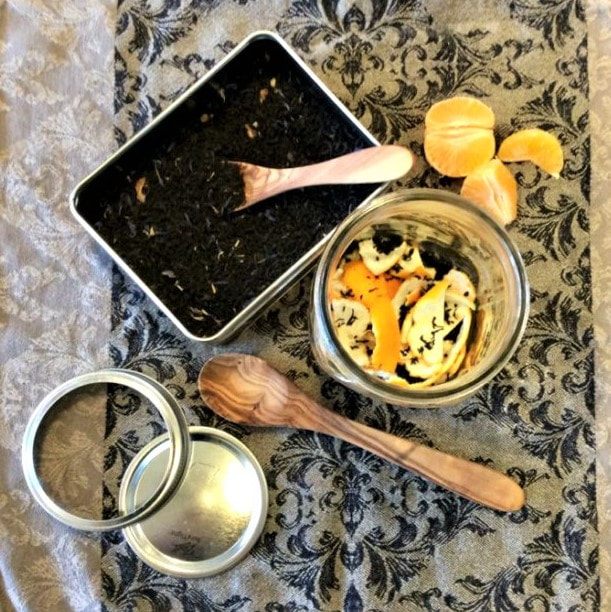
Earl Grey Cordial Part One

Quart Sized Jar with tight sealing lid  
6 oz loose-leaf Earl Grey tea [or contents of 5 tea-bags] 
Peel of one Orange [or 2 clementines] 
Vodka to cover [about 2 cups]
Add your tea leaves to the clean, sterile jar. Peel the orange, cutting your peel into strips to increase surface area.  Fill the jar with plain vodka to the top, seal it up, & shake to combine. Be sure all plant & fruit materials are covered by the alcohol. Label the jar with the date & set it aside somewhere out of direct sunlight. Head over & mark your calendar 2-4 weeks out with a reminder to strain it off. The longer you let it steep, the more intense the flavor, but 2 weeks is plenty of time to develop the delicious notes from the botanicals. Feel free to give your jar a shake every few days while it steeps.
Picture

Earl Grey Cordial Part Two

Steeped Tea-Vodka Base 
2 cups demerara sugar [or honey or xylitol] 
2 cups filtered water
Picture
Relaxing & Uplifting Cordial
Begin by creating a Simple Syrup to sweeten your base. You can use whatever sweetener you desire in a 1:1 ratio with fresh water. I prefer demerara sugar, but regular refined is perfectly acceptable, or honey, agave, etc. Add the water & sweetener to a saucepan, stirring to completely dissolve. Bring to a full-boil over medium heat, continuing to stir occasionally. Turn heat down & boil for roughly 3 minutes. Set aside to cool. Grab your jar of steeping tea leaves.  Double strain the contents into a large pitcher through a fine strainer or jelly bag. Compost the spent leaves & peel. Your Earl Grey vodka will be fragrant & dark, but quite bitter -- strong & unpalatable straight from the jar.
 The tannins extracted from the black tea leaves give it that deep, brown color & are extremely bitter on their own. Begin adding your cooled Simple Syrup to the pitcher, stirring it in as you go. I usually start off by adding half my syrup, then tasting to get a baseline. Continue adding & tasting until you get a blend that is just the right balance for your tastes. Most people will find their ‘sweet-spot’ adding all of the simple syrup, while some will like it a bit less sweet. If you add all of your syrup & still feel it is too bitter, or you wish to lower the alcohol content even further, you can add more water. Play with it until you get the perfect balance. Once you mix it up to your taste, decant it into pretty bottles. If you are feeling generous, a bottle of this is a lovely gift to any Earl Grey fan. Set your cordial aside for 24 hours to let the flavors meld together before drinking.

Enjoy a small glass of cordial on its own as the perfect Low alcohol [ABV] end-of-the-day treat. It is also quite lovely to add a splash to a nice cup of Chamomile tea! You can also get creative with it & mix up some fun cocktails! I find it plays well with champagne, gin, & bourbon. I love to include it in a French 75, but am particularly fond of it in the following little number: 

The Caterpillar’s Kimono

2 oz Botanically-Forward Gin [such as Hendrick’s] 
.5 oz Earl Grey Cordial 
.75 oz Chamomile Bar Syrup 
Bar Spoon of Lemon Juice 
​
Egg White [optional, but gives phenomenal mouth feel!] 
Orange Twist for garnish
Add the gin, cordial, syrup, & lemon juice to a shaker. Fill with ice & shake until well-chilled & combined. Strain into a coupe glass & float the peel to garnish. OR, for a delicious & wicked creamy note & texture, do a dry-shake with the egg white like this: Add the gin, cordial, syrup, & lemon juice to a shaker. Fill with ice & shake until well-chilled & combined. Strain chilled ingredients into an empty shaker, throw out the ice. Add an egg white & dry shake vigorously for 15 seconds. This will create the frothy top & give lovely texture to your drink. Strain carefully into a coupe & float the orange peel on the foam to garnish.
Picture
The egg white gives this drink its creamy cap, but it is delicious with or without it.
And there you have it! I hope you enjoy this cordial & the process of making it! Do let me know if you get creative & mix up something fun with it--I love to hear from you all!  Until next time--  
​
Take care & STAY SAFE!   #StopAndEatTheFlowers 
1 Comment

wow them: cardamom sugar cookies three ways including Stacked-Cookie Tree Centerpieces

11/30/2020

1 Comment

 
Picture
photo: leite's culinaria
Baking cookies for the Holidays is a family tradition I remember fondly from my own childhood that I have carried forward to continue with my own children. Here I am sharing our family recipe for Cardamom Sugar Cookies  & three ways to make them. It is simple, DELICIOUS, & easy to make. They can be as simple or ornate as you wish & will be tasty either way. These can be baked as simple drop cookies or rolled out & used with the cutters. If you have a set of different sized matching cutters, you might want to take advantage  & make Stacked Snowflake Cookie Trees with them too!
Stacked Cookie Trees make wonderful gifts or centerpieces for your table.
​Short stacks or tall, they always get the “Ooohh!” reaction!  I have made stacked cookie trees in the past with my star-shaped cutters, but I think the trees will be even more beautiful made with snowflake shaped cookies!
Couple tips before we start:
​If you are planning to roll out & cut shaped cookies, I highly suggest rolling your dough out BEFORE chilling it. This prevents cookie ‘spread’ when baking & will result in cleaner edges on your finished cookies. Use whichever icing recipes for decoration you wish. If you plan to create stacked trees with the cookies, you
will need a Royal Icing to hold them. I am sharing a link to a GENIUS recipe [with video!] for making Royal Icing with meringue powder -- which will hold them AND is actually edible as well [without cracking a tooth LOL] Check out this Sally’s Baking Addiction post all about it!
Picture
Picture
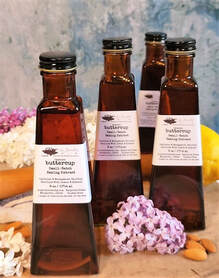
I use our Buttercup and Cardamom baking extracts in my version.
small-batch baking extracts
Trees can be any size from short to towering, but I find they hold best & are less likely to lean drunkenly at about 11 cookies tall with a tiny cookie ‘topper.’ They make gorgeous, edible decorations for the table.
Finally, if you do not have the baking extracts I use, you can always use what you do have on hand. I like to use our cardamom extract so my cookies remain a pale canvas;  adding ground cardamom [or nutmeg or cinnamon] will add tiny dark specks to the finished cookies. Tweak your flavors to fit your tastes & family-- This should be fun, so have fun with it! 
​
Okay, ​ Let’s do it:

Cardamom Sugar Cookies

2 ¼ cups all purpose baking flour 
1 ½ teaspoon baking powder 
½ teaspoon salt 
1 cup sugar 
1 cup vegetable oil 
2 large eggs 
½ tablespoon Buttercup baking extract [or vanilla] 
½ teaspoon cardamom extract [or 1 tsp ground cardamom]
Picture
Using our extract of cardamom gives us the flavor without tiny dark specks in the dough.
single note cardamom baking extract
buttercup baking extract
Picture


​Preheat oven to 350. Sift the flour, baking powder, & salt together. Mix the sugar & oil together. Add your eggs & baking extracts/spices to the sugar mixture, combining well. Slowly add in your flour mixture until completely incorporated & the dough comes together.
Picture
The bottom of these old glasses make beautiful cookies, no muss, no fuss!
For Drop Cookies:  Shape dough into balls, rolling each in a mixture of 2 TBS sugar + 1 tsp cardamom & place balls on lined cookie sheets, spacing 2” on all sides. Softly flatten each ball. I like to flatten ours with the bottom of drinking glasses I inherited from my mother; they have a pretty star shape that is just perfect for cookies. Some people use cookie presses, others simply flatten with the heel of their hands. Bake until just done 8-10 minutes.
Roll & Cut Cookies:
Cut your dough into 2 batches. Roll your dough out on baking liners or parchment to about ¼ ” thick. Chill rolled dough for one hour. Work with one batch at a time, keeping the other half of dough in the fridge until you're ready to cut it. Cut dough with cutters as desired, placing shapes onto baking trays with 1” between them.
Dough scraps can be gathered, re-rolled & cut. Bake until just done 8-10 minutes.
​Allow to cool completely on racks before decorating as desired.
Picture
Picture
Stacked Cookie Trees:
​Once your cookies are cool, make up your Royal Icing [again I recommend this recipe.] Begin building your tree by stacking cookies, slightly offsetting each, beginning with the largest & working up to smallest. Place a teaspoon or so of Royal Icing in the centers between them, twisting each cookie slightly as you work your way up. Save one of your smallest cookies to ‘stand’ on top as the tree topper. Allow your tree to harden.
​Once it has set, you can continue decorating your tree however you desire with candies, non-pareils & icing or even just give it a dusting of confectioner's sugar ‘snow’
There you have it! I would love to see your pictures -- please share!
Wishing you a wonderful, SAFE Holiday season filled with joy & love.
STAY SAFE!
1 Comment

Herbal Spotlight: Tulsi, one of our most important herbal allies

11/16/2020

0 Comments


​All hail the queen of Herbs! 
Current scientific studies have proven what herbalists have known for centuries-- Tulsi is one of our most important herbal allies.
Join me as we discuss just what it can do for you & how--
Picture
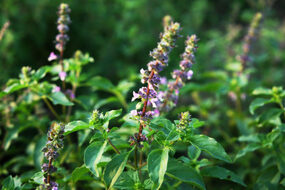
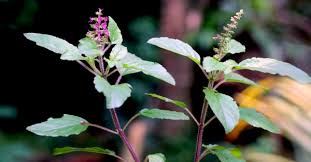
ABOUT:    Tulsi [Ocimum tenuiflorum] is an aromatic member of the Lamiaceae or mint plant family, easily recognizable by its square ‘hairy’ stems & distinctive fragrance. Also known as Holy Basil & the Queen Of Herbs, tulsi is cultivated around the world for religious & medicinal purposes. It has been used for centuries in Chinese & Ayurvedic healing, as well as in religious ceremonies. 
Picture
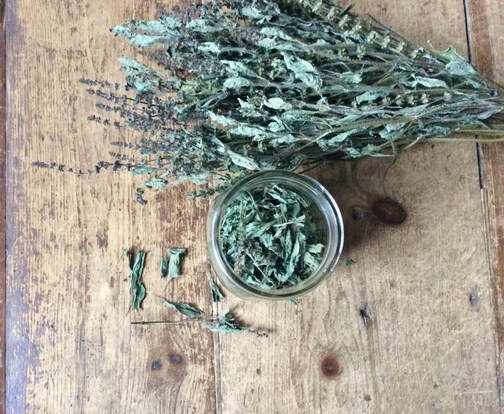
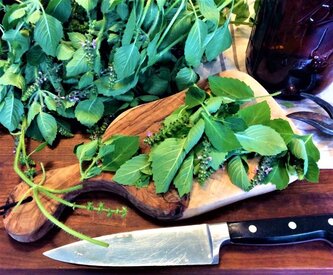
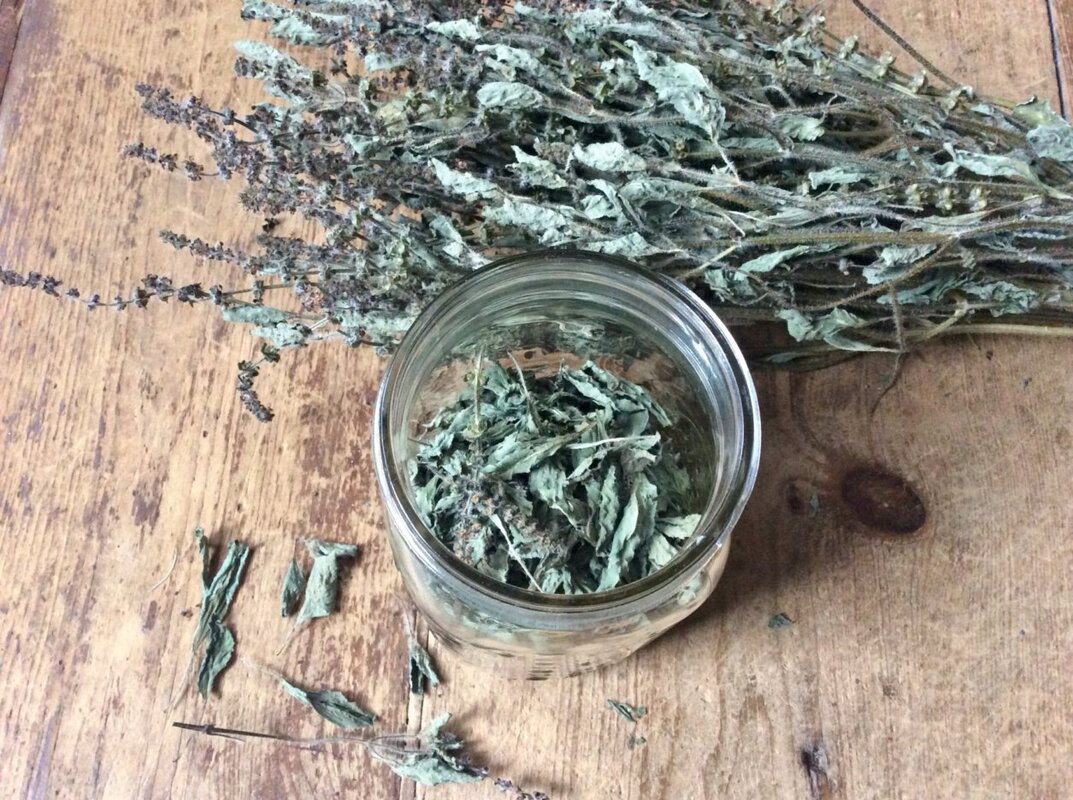
A bundle of tulsi dried for making tea
It grows easily & readily, & is an herb I feel everyone should give serious thought to adding to their gardens. I believe you will be thrilled with it-- & I know your local bees will be! Locally, both Goranson Farm & Morning Dew Farm sell seedlings in the Spring. Tulsi works as a powerful adaptogen. Adaptogens are substances that are considered to help the body resist stressors of all kinds, whether physical, chemical or biological, & to exert a normalizing effect upon bodily processes. Tulsi excels in this area -- 
Indeed, recent medical studies have shown Tulsi to actually lower cortisol levels [“The beneficial metabolic effects of tulsi are multiple and include lowering cortisol levels” Gholap S, Kar A.Pharmazie. 2004;59:876–8] in the body, so it is not just promoting feelings of wellbeing, but actually increasing our resilience to stress & our ability to handle it.
In addition to its adaptogenic properties, tulsi has also been found to have a modulating effect on the immune system, making it helpful in reducing symptoms of seasonal allergies & strengthening a healthy immune response, to improve memory, to focus attention, & to relieve depression & anxiety. Holy basil has even been shown to counter metabolic stress through normalization of blood glucose, blood pressure & lipid levels. The US National Institutes of Health has published an extensive report detailing many uses & studies.
Picture
​Read That study here:   ncbi.nlm.nih.gov/pmc/articles/PMC4296439/
Picture
My Tulsi Rose Lemonade is a favorite in our house
USAGE​:  There are many ways to effectively use tulsi in order to reap its benefits. One of the most popular ways to to use it in teas & tisanes; this can be done with fresh or dried leaves & flowers.I personally dry large amounts for this usage; it is a favorite with every member of my family. We've found a cup of tulsi tea with lemon balm before bed to be just the thing for a good night’s sleep. 
​ I also like to make syrups for drinks with tulsi -- Give it a try in your lemonade for a refreshing & uplifting treat!
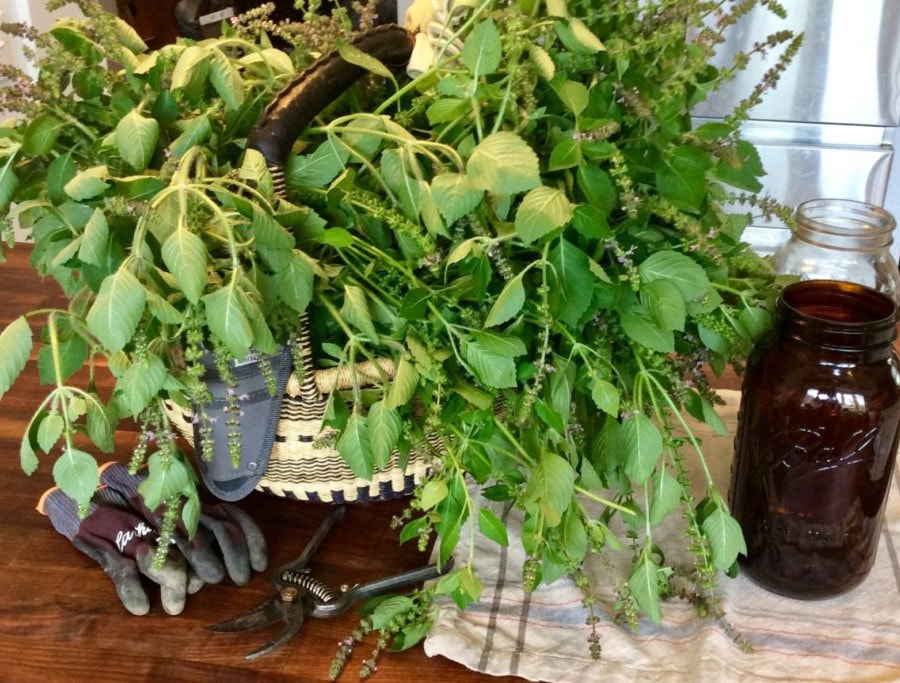
You can easily harvest & dry tulsi to make your own teas. Our plants were particularly prolific this year & I was able to bring in 4 huge harvests! I also dug up 3 plants after cutting them back & repotted them in containers indoors to prolong my access to fresh tulsi into the Winter. After harvesting, I sometimes garble it immediately & lay it to dry on drying-screens, but often I will simply hang bundles of long, cut stems to dry, then garble it into jars once it has completely dried. 
Picture
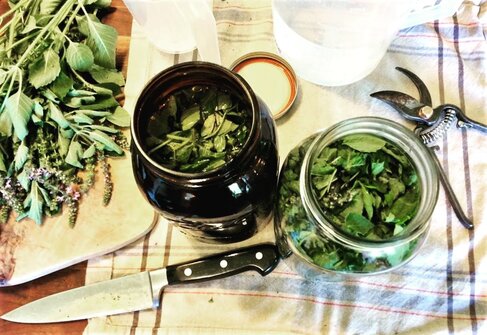
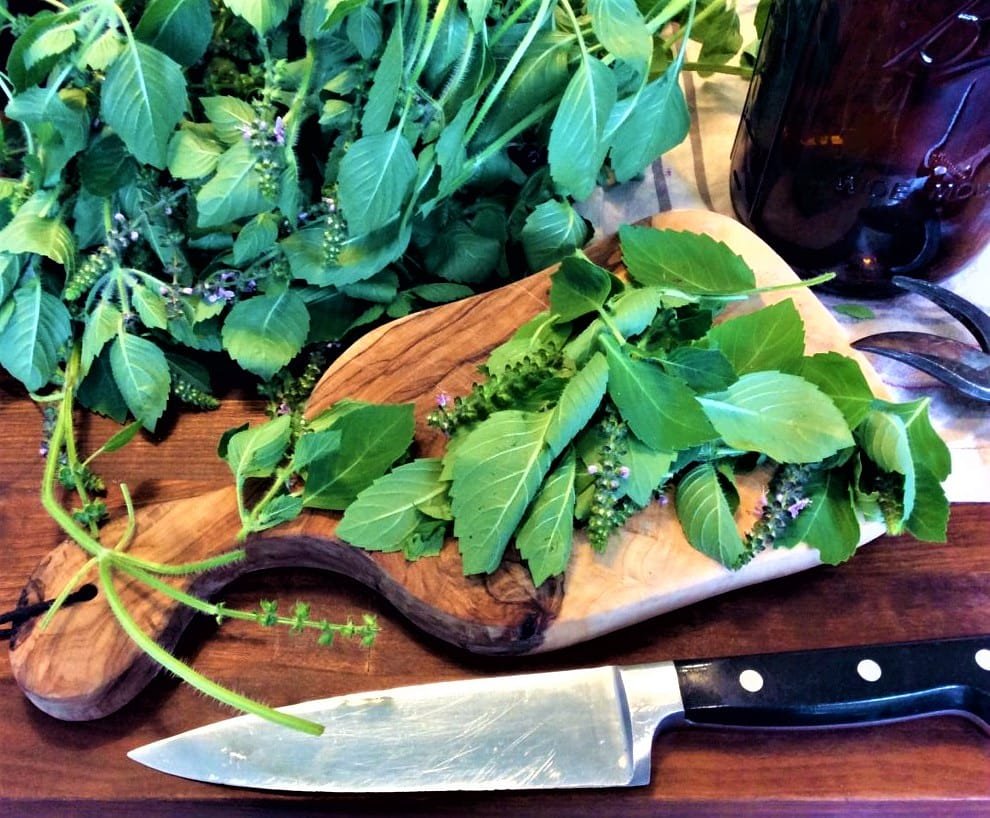
Garbling fresh tulsi
Picture
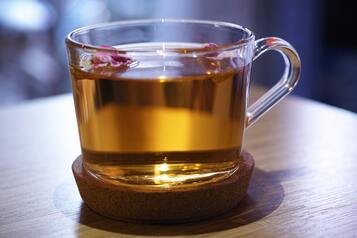
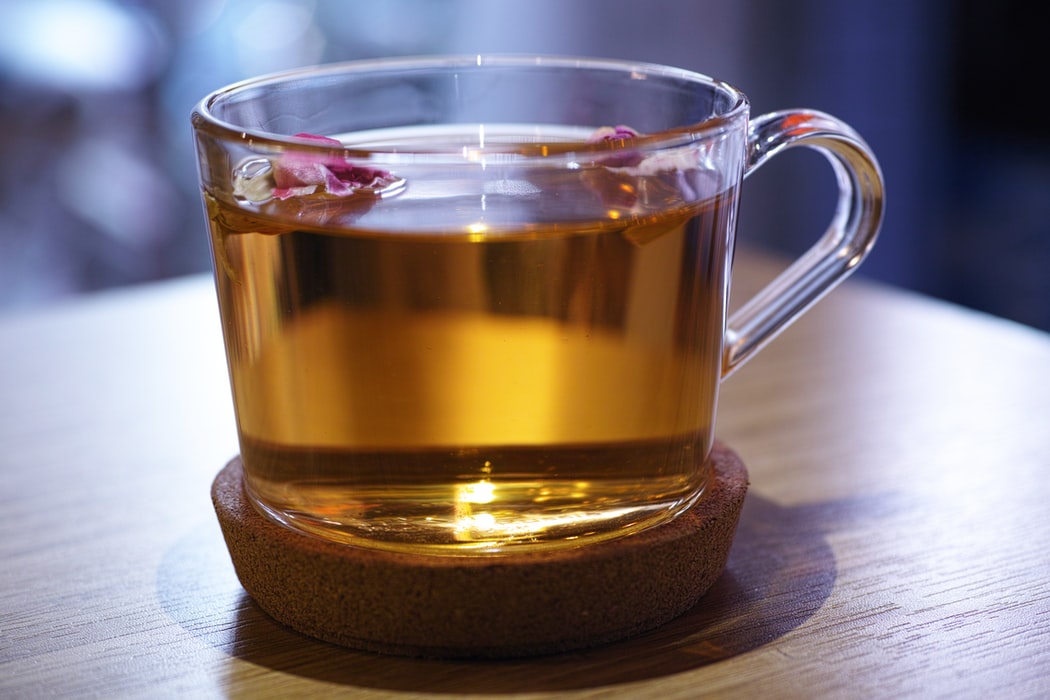
A lovely cup of tulsi & rose tea
 If you do not grow it yourself, you can find dried tulsi at most herb houses, like Mountain Rose Herbs. I love to mix up my own blends, depending on my specific needs & feelings each day. If you are looking for a little inspiration, I personally find tulsi works especially well with chamomile, rose, jasmine, rosehips, & lemon balm, as well as with green tea if you are looking for some caffeine too. If you prefer to buy it premixed or bagged, you will find numerous tulsi teas on the market, including our Botanical Bliss Tea & an amazing Tulsi + Rose one from Herbal Revolution.
SHOP THESE FABULOUS TULSI-CONTAINING PRODUCTS

Botanical Bliss Adaptogenic Herbal Tea With Tulsi & Butterfly Pea Flower

Shop

TULSI Tincture, Gluten-Free

Shop

Restore + Relax Herbal Tea from Herbal Revolution

Shop

In addition to being used as tea, tulsi is also steam-distilled to create essential oil & hydrosols. These can be applied to the skin or diffused in the home to help promote harmony. I enjoy bringing large ‘bouquets’ of cut stems & flowers inside to help fragrance our home too. This has the added benefit of ensuring I easily have fresh leaves at hand to muddle into drinks too. 
The most powerful means of using tulsi is by concentrating its constituents through tincturing. In pharmacology, a tincture is a type of medicine extracted from a plant in an alcohol solution. In order to achieve many of tulsi’s medical effects, one must sustain a constant level in the body; daily doses of tincture are an easy, effective method for achieving this. When choosing a tincture, look for how & where they are crafted; choosing 
Picture
learn more about our Small-batch tulsi tincture here
Picture
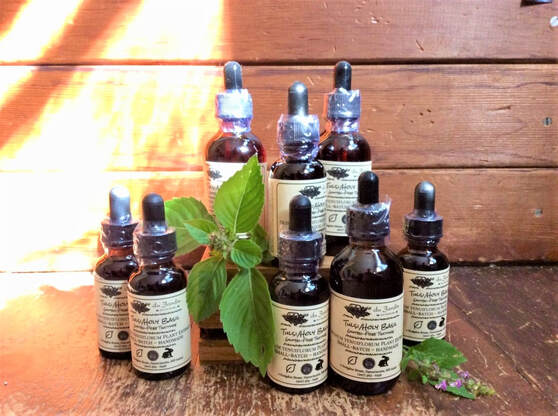
Our small-batch crafted Tulsi Tincture is gluten-free. Available in 1 oz and 2 oz bottles.
organic & unadulterated options from trusted sources is a good rule of thumb. Most will give guidelines for amount to take, with children’s dosing generally being half that of adults, but it is important to remember that every person is unique & will therefore interact with plant medicine in a unique way. You may experience a desired effect at a lower dosage or you may need a bit more than suggested. Therefore, it is best to discuss dosing with an Herbalist or your personal physician for best results. As always, if you are pregnant or nursing it is even more important to discuss usage with your doctor.
Well, that is about it for this week! I think you can see why I believe Tulsi to be such an important herb, & one that everyone should consider including in their lives!
​Hopefully, I have piqued your curiosity about this amazing herb. As you sit down this Winter to plan your garden beds for next spring, give some though to adding her to your mix!  I believe you will really enjoy it & all its benefits!   
Take care & STAY SAFE!   #StopAndEat TheFlowers 
0 Comments

Herbal Spotlight: Leeks, with my Ultimate Potato Leek Soup Recipe

10/19/2020

1 Comment

 
Picture
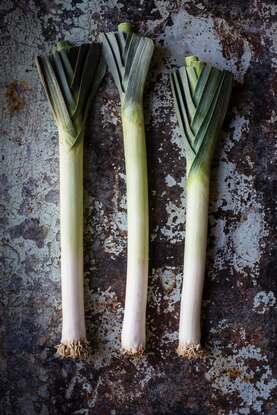
In this house, we all are fans of the entire Allium family, but leeks? Leeks hold a special place in my heart. Nutritious, delicious, & FILLING, they make a meal all by themselves. Join me as we put them in the spotlight & I share my recipe for potato leek soup with a special ingredient that puts it into the 'Ultimate' Category--
For some reason, leeks aren't as widely used here in the US as their relatives onions, shallots, garlic, & chives. This is a shame, as in addition to their mild-slightly-sweeter onion flavor, they provide a ton of amazing health benefits. L​eeks stimulate the immune system, support both the nervous system & cardiac health, protect against cataracts, assist in lowering blood pressure, & even reduce water retention! ​
Truly a superfood, they contain high levels of flavonoids, folate, Vitamins A & E, & fiber. Leeks are rich in potassium, calcium, magnesium, copper, & iron, & are completely fat-free! They also work well in side-dishes or in the leading-role for dinner. Typically, only the tender white & pale green parts are eaten, although many keep the dark greens for stock. If you buy them with the root-ends attached, you can replant those & they will grow & produce seeds-- a neat little $-saving trick!
Picture
Chart: whfoods.com
Here in Maine, we plant our leek-starts in Spring, my husband & I working as a team to separate each tiny seedling from the bunch & set them up in long rows of soil with some sand mixed in. After about 6 weeks, we hill the plants up, mounding sand & dirt around the bases of each to increase the edible growth. Once harvested, leeks will keep in the fridge [I wrap mine in a damp towel] for 2 weeks or so, or can be cleaned & stored in the freezer for about 3 months without losing too much flavor. I often make enormous batches of potato leek soup to freeze at harvest time as well, so we can enjoy the flavor of fresh leeks all winter long. The soup heats up well & makes for an easy diner on a cold night -- Simply grab a baguette, throw a quick salad together & you’re done!
Picture
My special ingredients
A bit about Potato Leek soups before we get to my recipe -- this recipe can be served a number of ways depending on your preference. Easiest as a classic chunky, rustic soup or simply pureed with an immersion blender, feel free to end it there & enjoy. With the addition of cream, it also makes a lovely Vichyssoise, traditionally served cold. Our family’s favorite way to enjoy it is what we call ‘warm Vichy’ -- where we add the cream after pureeing, then warm it back up to serve. It is lovely all four ways. If you are making it to freeze, hold off on adding the cream until reheating to serve. I use chicken stock in mine, but have made an equally tasty vegetarian version with Vegetable Stock too. Finally, my special added ingredient is CARROT -- both grated & the carrot greens. I find it a perfect pairing, with its sweetness adding a lovely high foil to the deep flavor of the soup. The greens also add an insane amount of Vitamin C, as they contain up to six times more than the roots do. DELICIOUS!​
Ultimate Potato Leek Soup
  • 4-6 leeks, white/light green 
  • 4-5 red potatoes, peeled/sliced  
  • 1/2 tsp turmeric  
  • 5 cups chicken stock  
  • 1/4 tsp 'Bell' seasoning [or sage]  
  • 2 or 3 carrots with greens  
  • 3 TBS unsalted butter  
  • Chopped flat-leaf parsley
Optional To Make it Vichy:  
Chives chopped  
1 cup Heavy Cream [Or half & half]
Trim off the root ends & tops of your leeks, leaving only the pale green & white portions. Slice leeks lengthwise & rinse under cold water to remove any sand & grit in the layers. Chop them all into half rounds. Finely grate the carrots. Keep the greens of one carrot, chopped roughly. In a large coquette, melt 3 TBS butter, add your sliced leeks & saute until softened & slightly browned, about 12 minutes. Stir in 5 cups stock, scraping the bottom to release any ​
Picture
Sliced lengthwise for easy cleaning
fond built up from the leeks. Add the sliced potatoes, carrot greens, & ¾ of your shredded carrots. Bring to a boil & simmer until the potatoes are cooked, about 30 minutes. Add your spices & S/P to taste. Stir in the chopped parsley. Leave it chunky if desired & serve, or puree your soup in the pot with an immersion blender. Stir in remaining shredded carrot. Serve with chopped chives to sprinkle on top! Or give 'Warm Vichy' a try.....
Picture
Stir in the cream [or half & half] with the remaining carrots to your pureed soup. Gently rewarm. Top each serving with a swirl of cream & chopped chives. Serve with crusty bread.

There you have it! 
I hope you give my recipe a try-- I think you will be thrilled with the results. Let me know which way you prefer to have your soup -- Rustic-Chunky, Pureed, or Warm Vichy!
  

That is all for this post-- See you all again in two weeks.

1 Comment

Herbal Spotlight: Quince, With My Poached Quince &  Membrillo  Recipes

10/5/2020

0 Comments

 
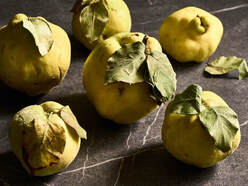
These ancient members of the Rose family have fallen from fashion in most cooking circles & are viewed by many as simply ornamental shrubs. If you live in New England, chances are you've got 1 or 2 in your yard, & it might just be the tastiest thing you didn't know you were growing. If you’ve never taken the time to harvest & cook some up, you don’t know what you’re missing!  Join me as we delve into harvesting & preparing quince, & just what to make with it once you do --
Picture
Picture
Quince shrubs & trees are grown all over the world, with recipes for quince dating back to ancient Rome. Their flowers herald Spring & are an amazing pale pink; every Winter, I bring branches inside to force & enjoy a bit of Spring in February. Like their relatives apples & pears, quince are also harvested in autumn. They store long & well, as most Fall crops do. Quince are loaded with Vitamin C & are a good source of calcium, iron, potassium, magnesium & copper. And the taste? Delicious -- delicate, sweet, & incredibly fragrant!
Quince are wonderful in desserts & drinks, jellies & pies, & also with savory items like hard cheese & meats. Why then do we not typically see bushels of them at the grocery store? I believe it is because quince are challenging to work with. Simply put, it’s delicious, but you are going to work for it --
​And it will be worth it!
There are many varieties, some are tiny & some larger, some are even covered in fuzz like a peach. All are challenging to peel due to their lumpy irregular-shapes, & are tough to cut & core. On top of that, they are basically inedible when raw -- in fact, the longer they are cooked, the tastier they get. Something truly magical happens when you poach them with sugar & a little water or wine. Not only does an amazing flavor develop, but they turn an  incredible rosy pink​!  The reward is absolutely worth the effort here-- especially when you factor in that most of us are growing & harvesting them for free with zero effort. 
Picture
Picture
A couple key factors to keep in mind when harvesting-- First off, if they are still green, tuck them aside to ripen fully. Quince grow a beautiful, golden yellow, some with a bit of a blush or small brown spots, when they are perfectly ripe. The riper they are, the more fragrant & delicious they will be. Second, plan an afternoon of processing, then you can use them at your leisure. A nice, rainy Fall-
afternoon with pots of quince simmering away on the stovetop filling your home with their fragrance is lovely instead of tedious. Lastly, I suggest poaching most of your haul. Poached quince is truly lovely on its own, baked into a pie, or used to top yogurt or waffles. Once poached, they will keep for about a week in the fridge or can be frozen in their syrup for up to six months. And don’t throw out that poaching liquid -- it is amazing for all manner of drinks & as an ice cream topper! You can even use it to make sorbet.
Picture
Picture
Prepare your space to clean them. You will need a large, very sharp knife, a paring knife, a peeler, & a bowl of water with a splash of lemon. Quince will brown like apple slices if exposed to air. As cleaning them is time consuming, I like to place my cleaned slices & halves into the water to keep them from discoloring--it also takes the pressure to hurry off me! Some people like to peel them whole, then set about coring them. I like to cut them in half, then quarters, then peel & core them. Some use a melon-baller to remove the seeds & woody core, I find the paring knife more effective.
Picture
While quince jelly may be the go-to recipe for most, my favorite is quince paste. [well, that & Quince Gin, see my other post!] Sweet Quince Paste is very popular in Italy & in Spain, where it is called membrillo, & is best served with hard cheeses such as Manchego or Parmesan Reggiano. I'll cover how to clean & poach your quince, as well as how to make this incredibly tasty fruit paste two ways. Here we go--
make your own quince gin
Take a moment to appreciate the fragrance coming off them as you work-- almost like vanilla & roses. They are hard to cut-- watch your fingers here! Cutting & coring is particularly hard if the fruit is not ripe. If you are planning to serve them simply poached, keeping them in lovely halves or quarter slices is preferred. If you will be making pie, or jelly, or quince paste with them, there is no need to be delicate about breaking them up. Do what you need to to clean ‘em. There is no rushing this step. Remember that ‘work’ I mentioned? This is it; the rest is just time. ​Once they are all cleaned, we are ready to poach our quince. Some people like to use honey, others sugar or a mix of the two. You will need roughly a cup of sweetener for every one pound of fruit. Some use water to poach, others champagne or Marsala wine to lovely effect. The method I am sharing is super basic in order to give me the most uses for the fruit [& liquid!] afterward.
Classic Poached Quince
2 lbs quince  
2 cups sugar, divided 1 ⅔  & ⅓  [⅓ is for paste to follow]  
1 or 2 whole Star Anise pods  
½  vanilla bean  
2 wide strips lemon peel
Clean & slice your fruit. Place your cleaned fruit into a coquette or large pot. Add enough water to completely cover it by 2 inches. Add 1 ⅔ cups of sugar*, lemon peels, the Star Anise, & vanilla bean to the pot. Bring to a boil over high heat, stirring to combine, then reduce to a simmer. Cook until quince is very tender & turns a pale pink, about 30 minutes. [*if simply poaching, add all the sugar in this step; reserve ⅓ cup if continuing on to make paste]

​
Picture
Picture
The syrup is a pale, blush pink.
Poached this way, your quince will keep in its syrup in the fridge for a week. You can use it in tarts or pies, or enjoy it as is. The syrup itself is precious & can be used to make many different things as I mentioned earlier. If you wish to make the Sweet Quince Paste, remove the peels, Anise pod/s, & vanilla bean, then strain your fruit from the poaching syrup. Set aside 1 cup of the syrup for your paste. I split the remaining liquid after that-- One bottle for the fridge & the rest goes into the freezer for later, where it will last up to a year
​Sweet Quince Paste
​
​
Poached Quince from above  
1 ½ TBS fresh lemon juice  
Reserved 1 cup poaching liquid  
Reserved ⅓ cup sugar
Picture
Return the fruit to the coquette, adding the reserved 1 cup of poaching liquid, the lemon juice, & ⅓ cup sugar. Bring to a boil over med-high heat, stirring frequently & pressing chunks with your spoon to break them down. Lower heat & continue to cook until reduced & thick; it will take on a raspberry-pink color as it continues cooking. Quince contain a lot of pectin, so it thickens up dramatically. I like to cook mine for about an hour, low & slow, to really develop the flavor.  Voila--paste No. 1. ​
Picture
Rustic Sweet Quince Paste
This is a ‘rustic’ version, chunky & thicker than jelly. You can run it through a fine sieve if you like it smoother. Delicious spread on crostinis, & served with hard cheese or pork.
​If you are willing to go one more step, you can continue on to make the Spanish style Membrillo, which is a set-gelled paste able to be cut into shapes or thin slices. very elegant in presentation, though the flavor will not change.
Picture
Membrillo-Style Paste: 
Preheat oven to 125 F. If your oven doesn’t go that low, cook it with the door slightly ajar -- the point here is to dry your paste out, not to cook it.  Line an 8”x8” baking pan with parchment paper & coat it with a thin layer of butter. Pour in your quince paste, smoothing into an even layer. Bake for 1 ½ hours to dry out. Cool before serving. 
There you have it! We are heading into prime quince season-- Hop on out there, pick yours & give ‘em a try!  I think you will be thrilled with the results.  Hope to see you there!   That is all for this week-- Stay safe & don’t forget to #StopAndEatTheFlowers
0 Comments
<<Previous
Forward>>

    Categories

    All
    Events
    Homesteading Tips
    Informational
    Ingredient Spotlight
    New Products
    Pet Care
    Recipes & Ingredients
    Soaps


    Picture
    Beautiful AND Responsible

      Sign Up Here For Our Newsletter

    Subscribe to Newsletter

    Picture
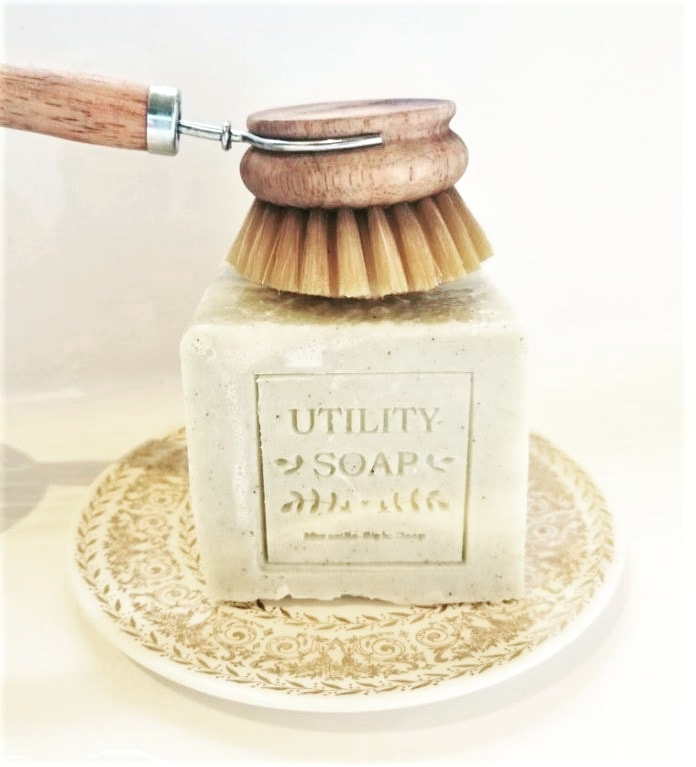
    Meet the Centuries-Old, French Cleaning Classic ​with A Modern Twist

    Author

    My husband & I were blessed with 2 beautiful girls. When I was diagnosed with MS, I couldn't keep up the pace working retail. We decided on a simpler life, built a cabin in the woods, & moved to mid-coast Maine ​


    Picture
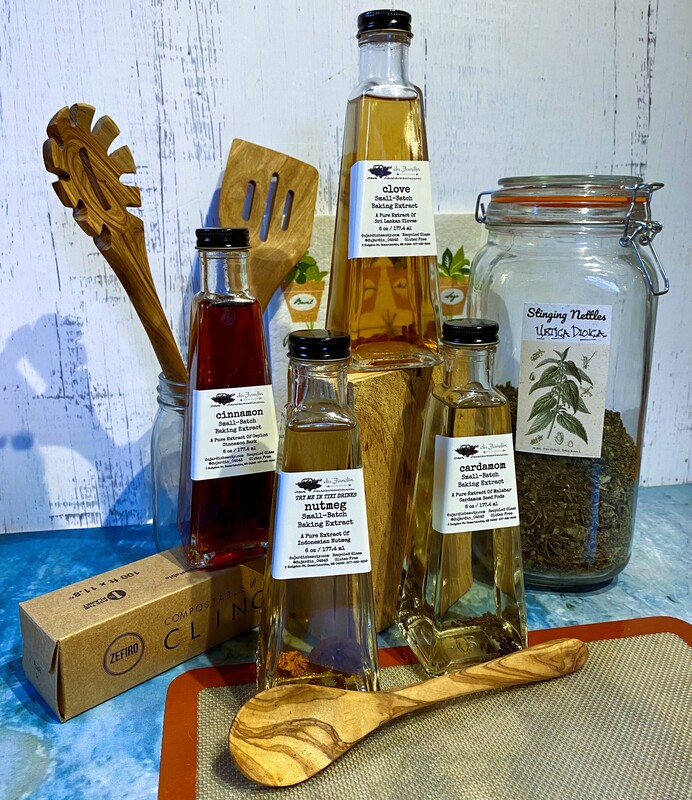
    Treat Yourself To Our Amazing, Handcrafted Extracts

    Archives

    July 2025
    May 2024
    March 2024
    February 2024
    November 2022
    October 2022
    March 2022
    February 2022
    December 2021
    November 2021
    October 2021
    September 2021
    August 2021
    July 2021
    June 2021
    May 2021
    April 2021
    March 2021
    February 2021
    January 2021
    December 2020
    November 2020
    October 2020
    September 2020
    August 2020
    July 2020
    June 2020
    May 2020
    April 2020
    March 2020
    November 2019
    October 2019
    August 2019
    July 2019
    June 2019
    May 2019
    April 2019

    Picture
    Discover Luxury Herbal Skincare For All Skin Types
    Picture
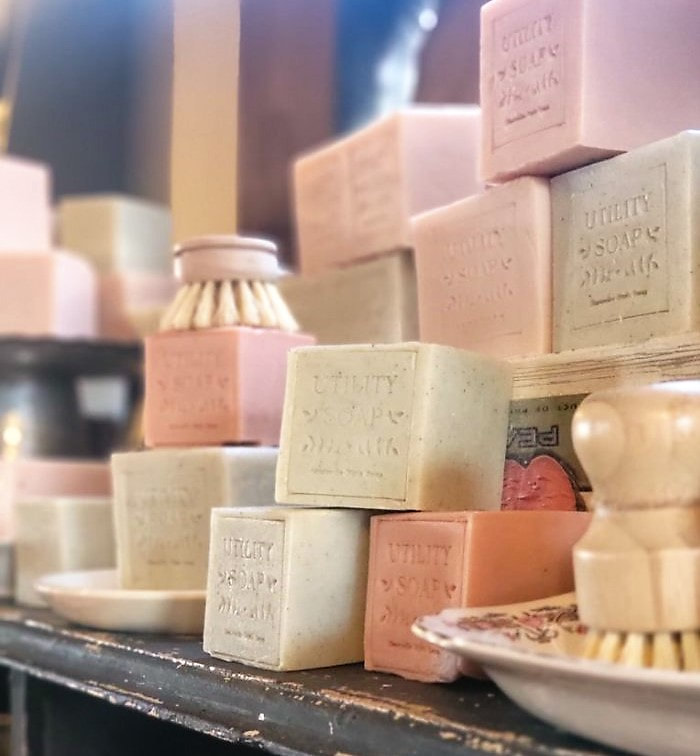
    Our Multi-Purpose Utility Soaps Are Our Best Sellers For A Reason! Find Out For Yourself!
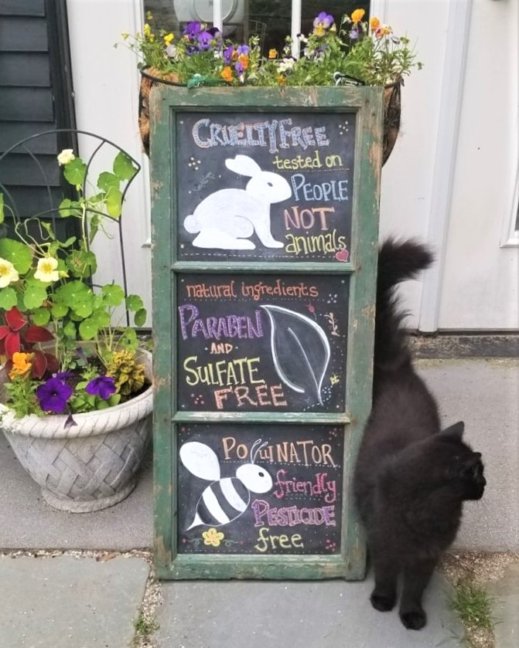
Always Free of Phthalates, Parabens, Formaldehyde-Releasers, Petro-Chemicals & Sulfates.
Store Hours:
Wednesday 11 am - 4 pm
​Thursday 11 am - 4 pm
​Friday  10 am - 4 pm
Saturday 11 am - 3 pm
Damariscotta Farmers Market:​
May 22 - Oct 30 2026

Interested In Being A Stockist?
 Click Here for Wholesale Info
contact us:
Picture

    Sign Up For Our Newsletter:  Recipes,
    Special Events, Promo Codes

Subscribe to Newsletter

207-563-6256      [email protected]       © Du Jardin 2019 

127 Elm Street  Suite #2 -  Damariscotta, Maine 04543